Business-model knowledge library
Key Models
A decision library for business models and strategy frameworks, with search, model pages, semantic diagrams, templates, packs, and editorial QA workflows.
Scroll to explore ↓
The project / 01
A closer look.
A knowledge product that turns a large corpus into a navigable product surface with source-faithful visuals, practical templates, and reviewable quality systems.
Product strategy, information architecture, corpus migration, semantic visual system, article UX, template productization, QA workflows, and full-stack implementation.
Business-model knowledge library
Live knowledge product · Decision library and templates
The thinking / 02
The idea behind
the interface.
What needed to change
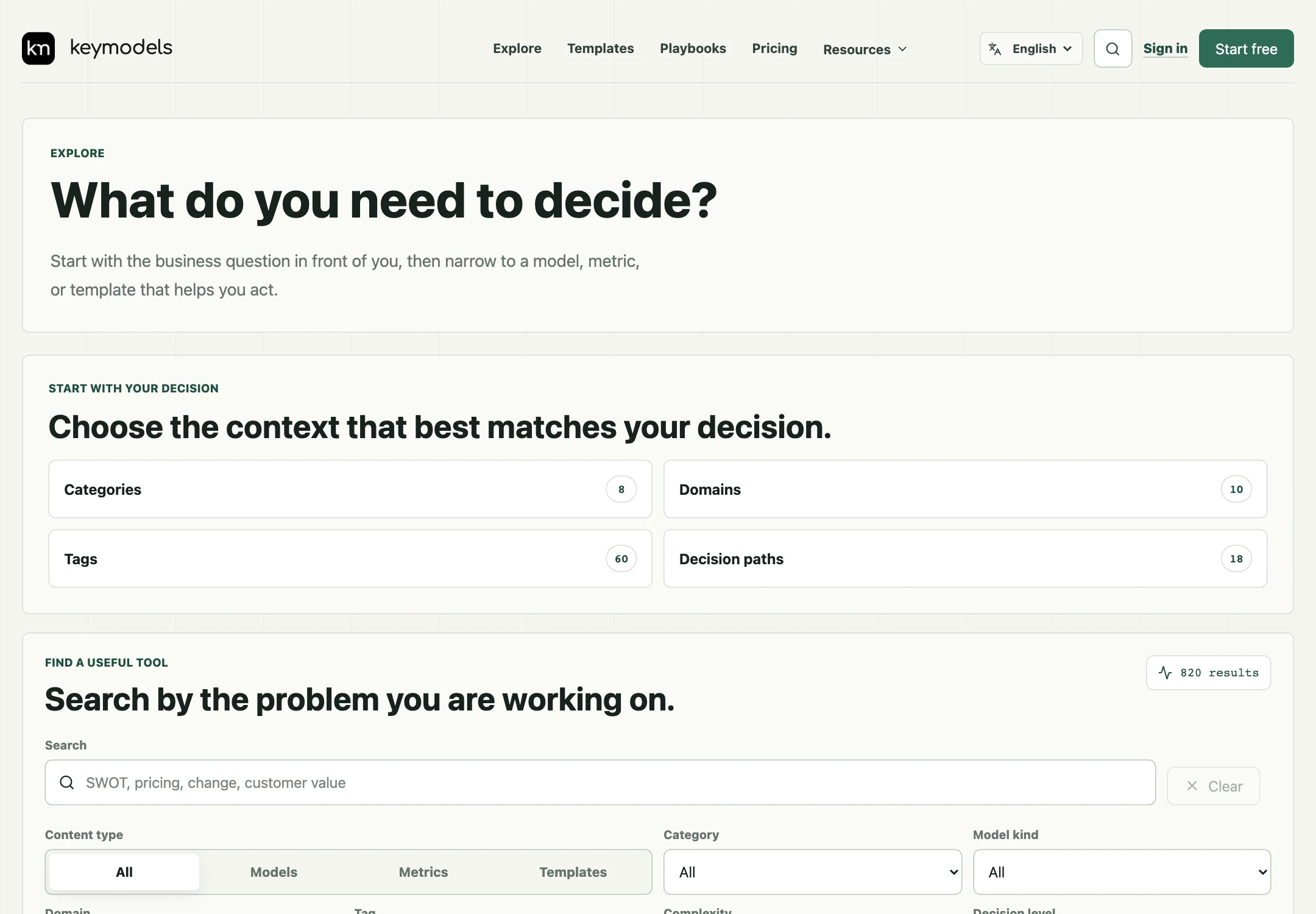
A large personal knowledge corpus can become valuable but hard to trust: different formats, uneven depth, visual inconsistency, source ambiguity, and hundreds of models that are difficult to choose from when a real decision is at stake.
What I made
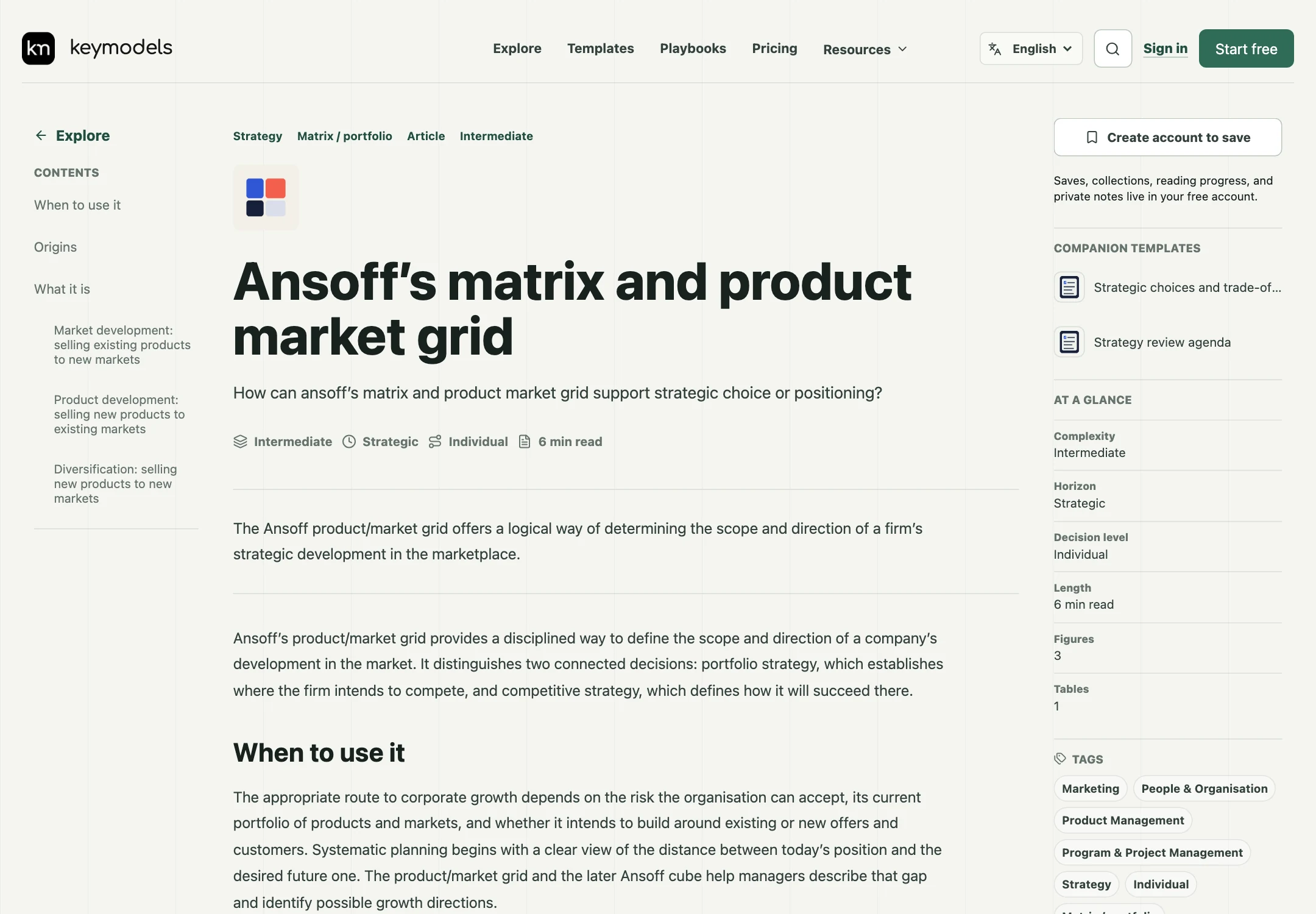
A business-model knowledge product with searchable records, article pages, semantic visuals, templates, packs, saved-library paths, protected resources, and an editorial QA workflow backed by a durable review ledger.
What it shows
That I can turn accumulated knowledge into a product system: information architecture, source fidelity, template productization, visual treatment lanes, review states, and growth loops rather than a static archive.
In the details / 03
Selected screens & momentsThe work,
up close.
What matters here / 04
More than
a screen.
Turns a large strategy corpus into searchable model pages, templates, packs, and saved-library surfaces.
Makes abstract frameworks legible through semantic diagrams and source-faithful article rendering.
Full case study available with corpus architecture, review workflow, template productization, and QA evidence.
Product decisions
What shaped it.
The library had to answer a user question before showing a model.
I organized the product around decision context: search, categories, model metadata, related frameworks, templates, packs, and saved-library paths that connect reading to action.
Manual review became a product workflow.
I turned the process into a two-pane real-page review dashboard with a JSON ledger, Excel snapshot, queues, notes, and approve/save-and-next actions.
Developer-facing assets became reader-ready resources.
I reframed the output around what a serious reader or buyer should receive: editable docs, spreadsheets, PDFs, Markdown, completion guidance, and stable responsive layouts.
 Next project DeMoreto↗