Selected case study

Report 02 / Business-model knowledge library

Live knowledge product with reviewed content, figures, and resources.

02

Key Models

Business-model knowledge library

A knowledge product for business models, decision frameworks, metrics, templates, and practical operating resources.

1

Hypothesis

A knowledge product has to help people choose, not just browse.

The product bet was that business frameworks become more useful when they are organized around decisions, constraints, questions, visuals, and practical outputs.

Decision path

The job is not collecting models. It is helping a reader find the right model for the decision.

2

Coded prototype

The corpus became a generated product surface.

The rebuilt app turns a canonical corpus into routes, search indexes, article pages, visual components, templates, packs, and account-aware library surfaces.

Generated surface

The product is a content operating system, not a static article archive.

3

Launch gate

Source fidelity became the quality bar.

The review system separates source-faithful figures, generated diagrams, article formatting, internal links, public previews, and protected working files so the product does not publish plausible-but-wrong knowledge.

Review gates

AI-assisted production only works when the acceptance criteria are more rigorous than the generation.

4

Feedback loop

The operating loop is a reviewable ledger.

The strongest product evidence is the machinery around the site: editorial queues, formatting review, figure review, internal-link audits, resource checks, and generated snapshots.

Quality loop

The product keeps improving because the work leaves a system behind it.

Contents · 10
  1. 01 - Brief
  2. 02 - Claim
  3. 03 - Screens
  4. 04 - Strategy
  5. 05 - System
  6. 06 - Risks
  7. 07 - Stories
  8. 08 - Method
  9. 09 - Ops + trust
  10. 10 - Signal
The 90-second brief

The problem

A large personal knowledge corpus can become valuable but hard to trust: different formats, uneven depth, visual inconsistency, source ambiguity, and hundreds of models that are difficult to choose from when a real decision is at stake.

What I designed and built

A business-model knowledge product with searchable records, article pages, semantic visuals, templates, packs, saved-library paths, protected resources, and an editorial QA workflow backed by a durable review ledger.

What it proves

That I can turn accumulated knowledge into a product system: information architecture, source fidelity, template productization, visual treatment lanes, review states, and growth loops rather than a static archive.

Product owner-builderRole
Live knowledge productStatus
Source fidelity, figures, resourcesTrust surface
Editorial ledger and review gatesOperating model

01 / Builder signal

Knowledge-product architecture, semantic fidelity, and reviewable production systems.

Key Models shows how I turn a large body of strategy knowledge into a usable product system: corpus architecture, generated routes, article reading experience, semantic diagrams, templates, source boundaries, internal linking, and review workflows.

Library scale
550 records across models, templates, categories, and decision paths
Template layer
68 templates and 272 ready-to-use files
Editorial QA
597 pages, 515 figures, and 276 resources reviewed in the local ledger
The story

A personal corpus became a product system.

Key Models started from years of accumulated business frameworks, diagrams, notes, and resources. That history is the value, but it is also the product challenge: material collected over time rarely arrives with one taxonomy, one source standard, one visual grammar, or one quality bar.

The product work was therefore not just publishing content. It was deciding how a reader should enter the corpus, how models should be classified, what makes a source authoritative enough, when a visual should be coded and when the original image preserves meaning better, and how hundreds of review decisions stay durable.

The case is a different kind of proof from the SaaS products. It shows information architecture, editorial operations, semantic visual judgment, template packaging, and a review system that keeps quality from living only in memory or chat.
02 / Product evidence

Screenshots selected as product evidence, not decoration.

Selected screens from the actual product.

Curated live-product captures, cropped for readability so the product proof stays inspectable.

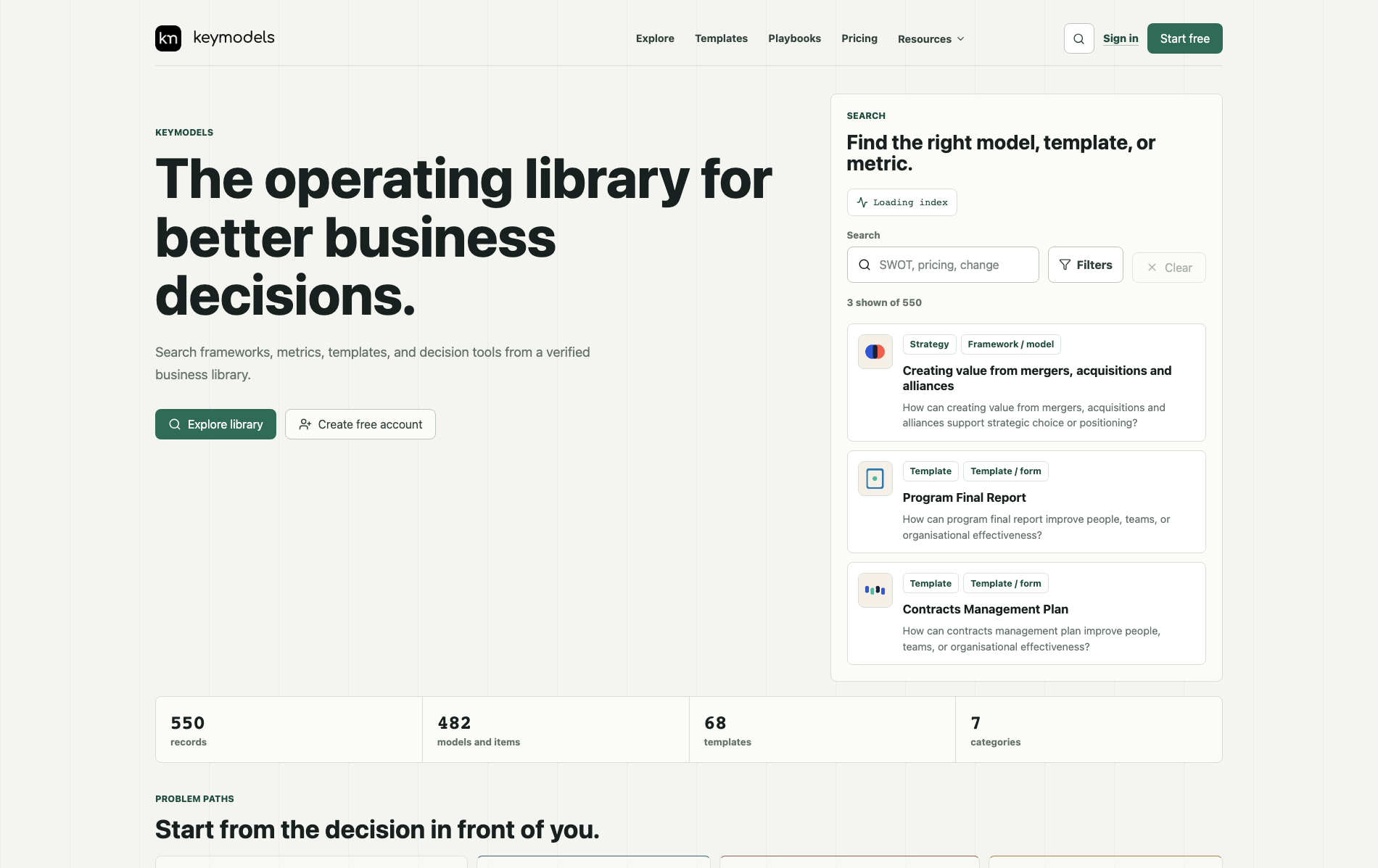
Key Models homepage with search, model results, and library counts.
Fig. 02 - Search, records, templates, and categories in one product surface.
  1. 1
    Decision-first search

    The product starts with the reader’s decision context, not with a raw encyclopedia of frameworks.

  2. 2
    Structured corpus signals

    Counts, categories, templates, and model types make the size of the corpus legible without asking the reader to browse everything.

  3. 3
    From article to artifact

    Templates and resources turn framework knowledge into something a user can apply, edit, and return to.

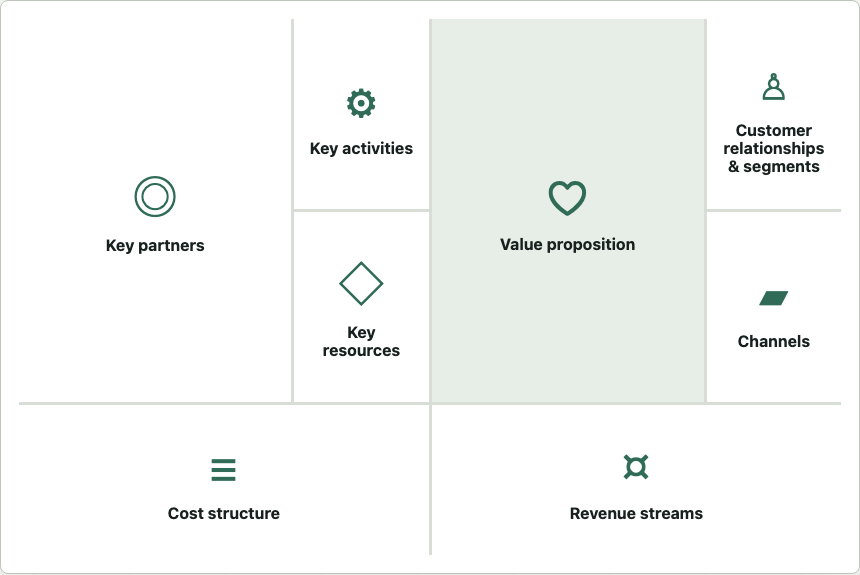
Key Models business model canvas diagram rendered as a semantic article visual.
Semantic visualFrameworks become inspectable diagrams, not decorative images.

The article system can render model-specific visuals while preserving the decision structure the reader needs.

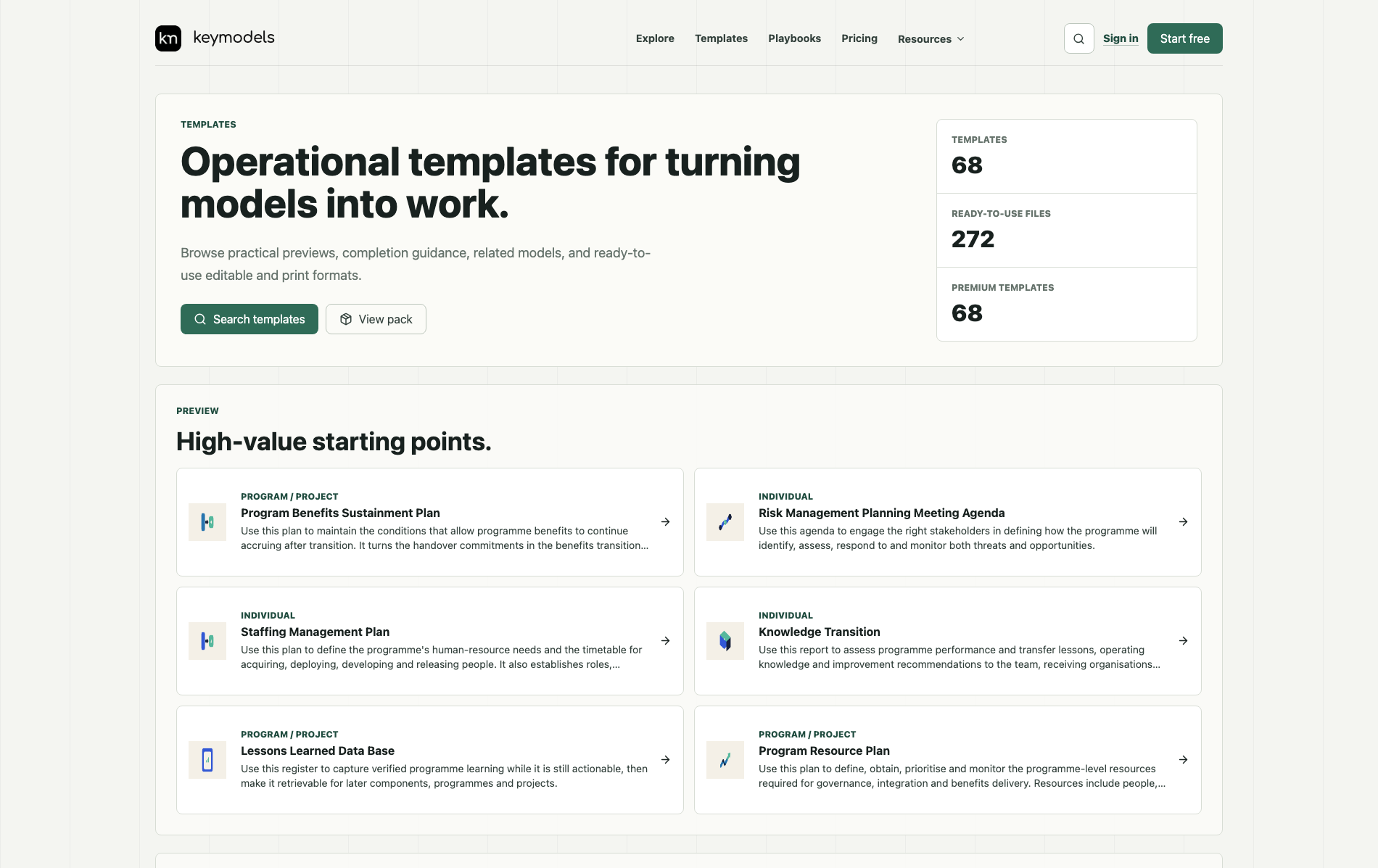
Key Models templates page showing template counts and high-value starting points.
TemplatesFramework knowledge turns into usable working files.

Templates create a product layer beyond reading: previews, guidance, editable files, and resource packaging.

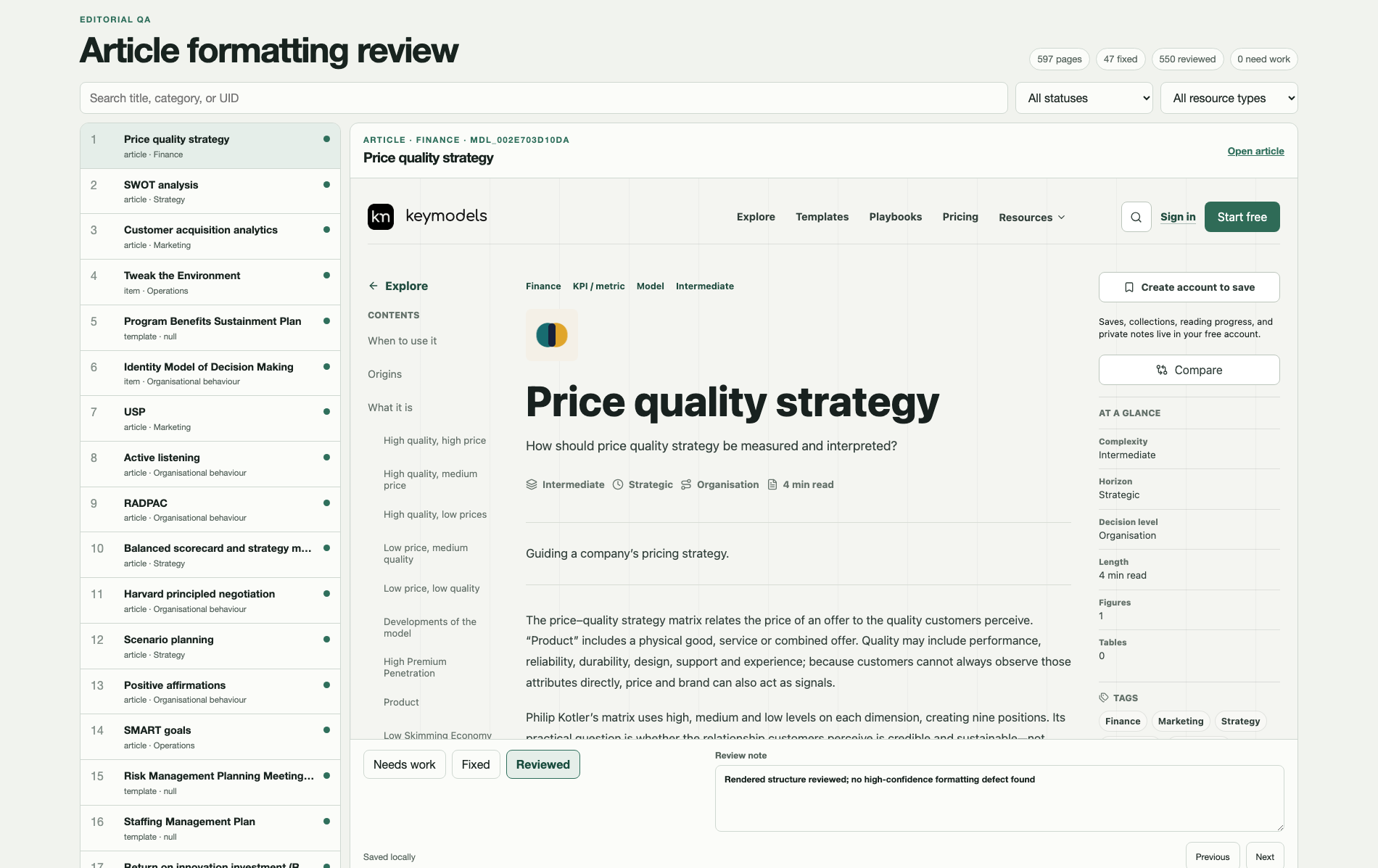
Key Models editorial formatting review dashboard with queue, article preview, and review status controls.
Review workflowEditorial QA became a workflow product.

A review dashboard tracks pages, fixes, status, article previews, and review notes so quality is operational.

03 / Strategy choice cascade

The chain of choices behind the product direction.

This section is the product-management read: who the product is for, where it starts, how it can win, what capabilities matter, and how the work keeps learning.

Aspiration

Become an operating library for better business decisions, not just a framework encyclopedia.

Where to play

Operators, founders, strategists, consultants, and teams who need practical decision tools.

How to win

Combine searchable model knowledge, semantic visuals, templates, packs, source boundaries, and reviewable quality systems.

Capabilities

Next.js app, generated corpus projections, article renderer, semantic visual registry, search facets, templates, and account-aware resources.

Management system

Editorial ledger, figure review, formatting QA, internal-link audits, source checks, protected-resource boundaries, and generated snapshots.

04 / Product map

The users, surfaces, and capabilities behind the product.

Solo product builder across product strategy, information architecture, corpus migration, visual system, article UX, template productization, QA workflows, and full-stack implementation.

Users

  • Founders and operators
  • Strategy and product teams
  • Consultants and business readers

Product surfaces

  • Library search
  • Model articles
  • Semantic diagrams
  • Templates
  • Packs and saved library

Capabilities

  • Corpus generation
  • Editorial QA
  • Internal linking
  • Resource packaging
  • Protected downloads

05 / Product-risk model

Value, usability, feasibility, viability, and trust.

The risk map shows what had to be true before the product could be treated as more than a concept.

Value

Does the library help with real decisions?

Records are organized by question, category, model kind, domain, complexity, horizon, and decision level.

Usability

Can readers find and understand the right model?

Search, filters, article rails, metadata, related links, and diagrams reduce the burden of browsing a large corpus.

Feasibility

Can a large corpus become a maintainable app?

The repo uses generated registries, route maps, source boundaries, visual registries, and validation scripts.

Viability

Can knowledge become a product, not only content?

Templates, packs, saved library, pricing surfaces, account access, and protected resources create product depth beyond articles.

Trust

Can AI-assisted content production stay source-faithful?

The local review ledger tracks reviewed pages, figures, resources, formatting issues, source checks, and remaining work.

The lesson

At scale, quality has to become a workflow.

The strongest Key Models decision was refusing a technically convenient answer when it damaged meaning. A bulk SVG conversion could satisfy a build request while losing labels, relationships, sequence, or the point of the original figure.

That turned into a broader rule: formulas, tables, charts, diagrams, documents, and illustration-dependent assets need different treatment lanes. Source fidelity became the acceptance criterion, and the review ledger became part of the product rather than an internal chore.

06 / Product learning stories

Specific moments where judgment changed the work.

Interview-grade product stories: what was ambiguous, what I chose, and what the product learned from that decision.

Decision architecture

The library had to answer a user question before showing a model.

Constraint
A large corpus of frameworks can become a beautiful archive that still leaves the reader asking which model applies, when to use it, and what to do next.
Decision
I organized the product around decision context: search, categories, model metadata, related frameworks, templates, packs, and saved-library paths that connect reading to action.
Proof
Key Models now presents models, templates, metrics, and categories as one navigation system, so a reader can move from question to framework to reusable artifact without treating every article as an isolated page.
Review workflow

Manual review became a product workflow.

Constraint
Chat-based review could not keep approvals, notes, corrections, figures, and resources synchronized across a large knowledge corpus.
Decision
I turned the process into a two-pane real-page review dashboard with a JSON ledger, Excel snapshot, queues, notes, and approve/save-and-next actions.
Proof
The workflow now keeps page decisions, figure decisions, resource checks, fixes, and review notes inspectable.
Template productization

Developer-facing assets became reader-ready resources.

Constraint
Template pages exposed fields, schemas, protected-resource metadata, and internal implementation concepts that would not help a real reader.
Decision
I reframed the output around usable artifacts: editable documents, spreadsheets, PDFs, Markdown, completion guidance, and stable responsive layouts.
Proof
The template layer became a product-design exercise, not just a file conversion exercise.
Knowledge graph

One internal-link insight became corpus-wide navigation.

Constraint
Hundreds of related frameworks behaved like isolated documents, which made the library harder to browse and learn from.
Decision
I built an idempotent relationship audit that added contextual internal links while avoiding self-links, broken destinations, bibliography pollution, and ambiguous matches.
Proof
The product gained a stronger knowledge graph and a cleaner path between related models.

07 / Method bridge

How this case maps to the operating model.

Each flagship case shows the same pattern: use AI for leverage, keep judgment human, reduce product risk, and leave an operating loop behind the product.

AI-assisted build

Brief before build.

The work depends on product briefs, real-codebase context, implementation review, validation checks, and careful claims rather than one-off prompting.

Product judgment

Knowledge-product architecture, semantic fidelity, and reviewable production systems.

The case reduces the major product risks while making the trust surface explicit: value, usability, feasibility, viability, and launch confidence.

Next learning loop

Live knowledge product with reviewed content, figures, and resources.

The next step is better evidence: user behavior, pilot feedback, operational checks, security posture, and roadmap decisions.

Read the playbook

08 / Operating loop

How the work moved from idea to launchable system.

  • Canonical corpus stays separate from generated app artifacts so content provenance remains traceable.
  • Editorial-review ledger records page, figure, and resource state while a readable workbook provides a review snapshot.
  • Article formatting review, visual review, internal-link audits, and source-title checks turn quality into repeatable workflows.
  • Template generation turns strategy knowledge into downloadable docs, workbooks, PDFs, and Markdown resources.

09 / Trust layer

Trust as part of product management.

  • Public previews remain separate from protected template downloads and source-only provenance files.
  • Account, billing, analytics, and protected file delivery boundaries are documented as product contracts before full rollout.
  • Security headers, source checks, route validation, and deployment preflight scripts reduce accidental exposure and broken public surfaces.

10 / What this shows

The capability signal for product teams.