Report 03 / Job architecture and compensation intelligence
Pilot-stage product with deep product, compliance-readiness, security, and pricing systems.
03
Gradimio
Job architecture and compensation intelligence
A Spain-first platform for role architecture, job evaluation, compensation decisions, pay transparency workflows, reviewable evidence, exports, and compliance readiness.
Compensation work needs traceable decisions, not just outputs.
The product starts from HR, legal, finance, and compensation teams that need explainable decisions, source maps, review workflows, and evidence they can defend.
Decision chain
RoleValueBandEvidenceReport
A high-stakes domain where product copy must avoid overclaiming.
2
Coded prototype
The system became a living compensation workspace.
The product spans puestos, job descriptions, factor valuation, employee mapping, imports/exports, compliance modules, evidence vaults, intelligence, pricing, and entitlement architecture.
Product modules
role catalog
factor valuation
pay register
evidence vault
Real-codebase product leverage in a regulated, data-heavy domain.
3
Launch gate
Security and governance sit inside the product promise.
Responsible product work: do not turn sensitive data into casual automation.
4
Feedback loop
The learning loop is evidence quality.
The strongest signal is the corpus of validation runs, manual review batches, pricing tests, source-policy decisions, compliance gap analysis, and roadmap discipline.
Evidence loop
source quality
review decisions
pricing bands
roadmap gaps
Evidence-guided execution without pretending the product is legally complete.
Compensation decisions are high-stakes: teams need role architecture, pay evidence, regulatory interpretation, reviewer confidence, and privacy-aware workflows without turning sensitive data into casual automation.
What I designed and built
A compensation-intelligence product with role catalogs, factor valuation, employee mapping, compliance views, source maps, evidence packs, pricing/entitlement logic, exports, and security hardening.
What it proves
That I can convert regulation, methodology, data sensitivity, and evidence quality into product behavior while keeping human review and claim boundaries explicit.
Product owner-builderRole
Pilot-stage productStatus
Compensation data and evidenceTrust surface
Regulation-to-product gatesOperating model
01 / Builder signal
Complex B2B product thinking for sensitive, evidence-heavy decisions.
Gradimio shows how I work in a sensitive B2B domain where source grounding, auditability, privacy, human review, legal boundaries, pricing, and product architecture matter as much as the interface.
Domain
Spain-first compensation and compliance readiness
Product model
Roles, employees, valuation, reports, evidence
Packaging
Inicial, Profesional, Empresa
The story
Regulation became a product model before it became automation.
Gradimio is the clearest evidence-heavy B2B case. The product could not simply show compensation charts and call them intelligence. In this domain, the hard part is deciding what the chart means, what it must not claim, and what source or workflow supports the decision.
The work translated Spanish and European pay-transparency obligations into product objects, reviewer states, caveats, evidence packs, permissions, reports, and unresolved decisions. That separation matters because a useful internal metric is not automatically a legal conclusion.
The case shows product management before modification: understand the repository, map the domain, name the risks, define evidence, and only then turn selected parts into product behavior.
02 / Product evidence
Screenshots selected as product evidence, not decoration.
Selected screens from the actual product.
Curated live-product captures, cropped for readability so the product proof stays inspectable.
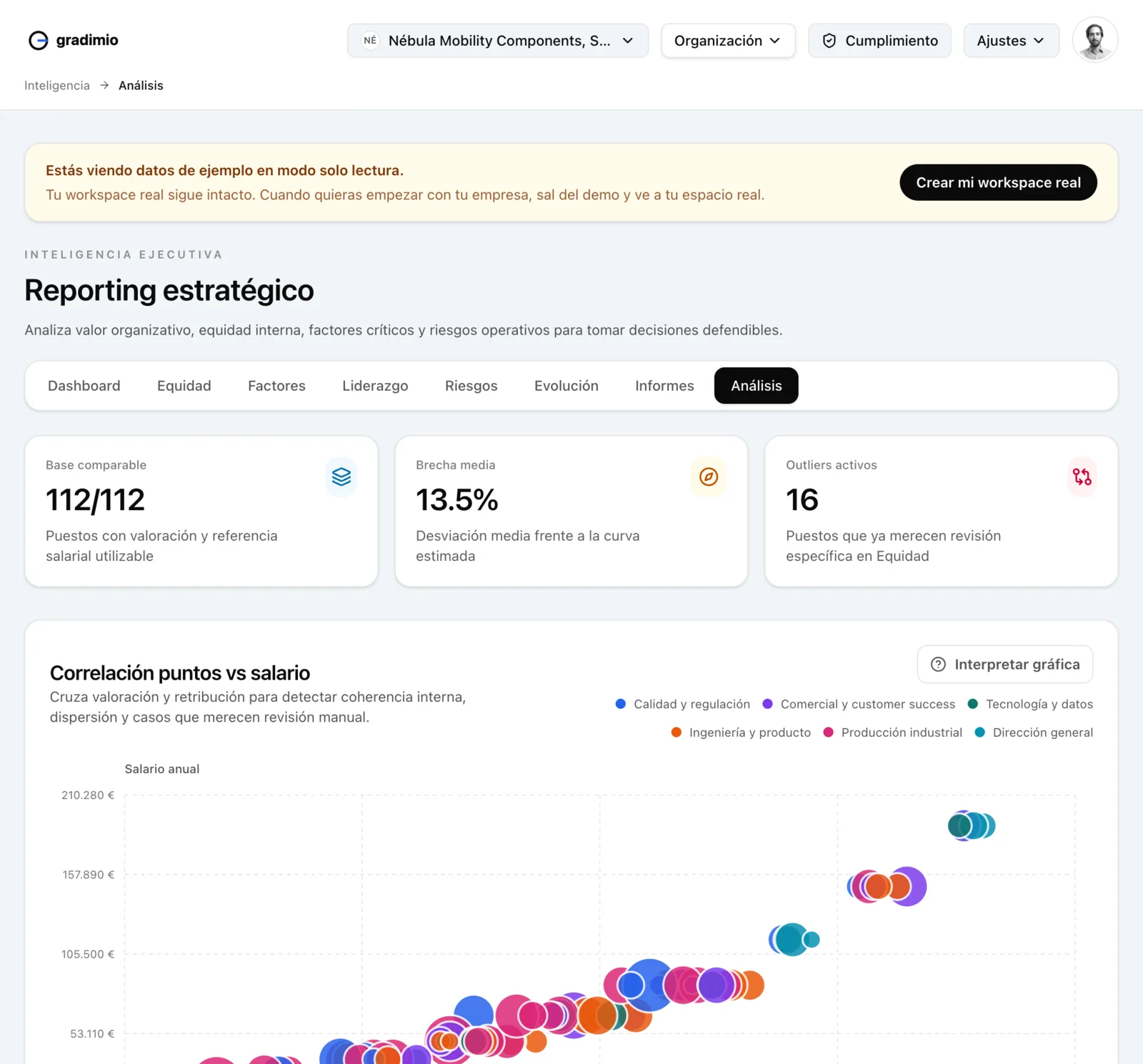
123Fig. 02 - Compensation analysis with chart, filters, and table evidence.
1
Executive context before analysis
The page frames what the user is seeing before asking them to interpret the compensation data.
2
Evidence stays close to the chart
Charts, filters, legends, and tables remain connected so the product does not turn sensitive decisions into black-box output.
3
Reviewable operating surface
Compliance, organization context, and settings remain visible because the product sits inside a governance workflow.
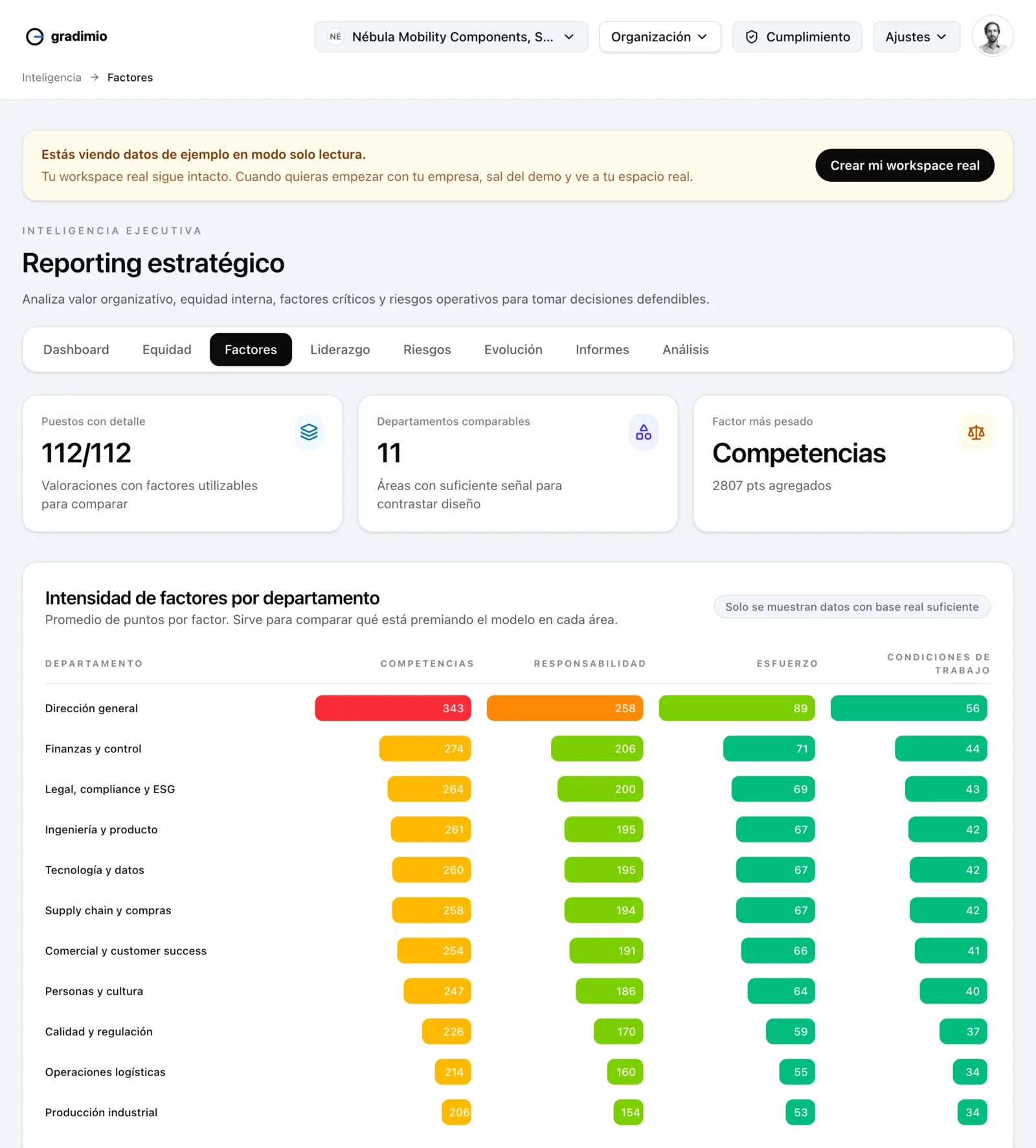
FactorsA factor heatmap makes job architecture inspectable.
The matrix gives HR and compensation teams a way to compare roles without hiding the criteria.
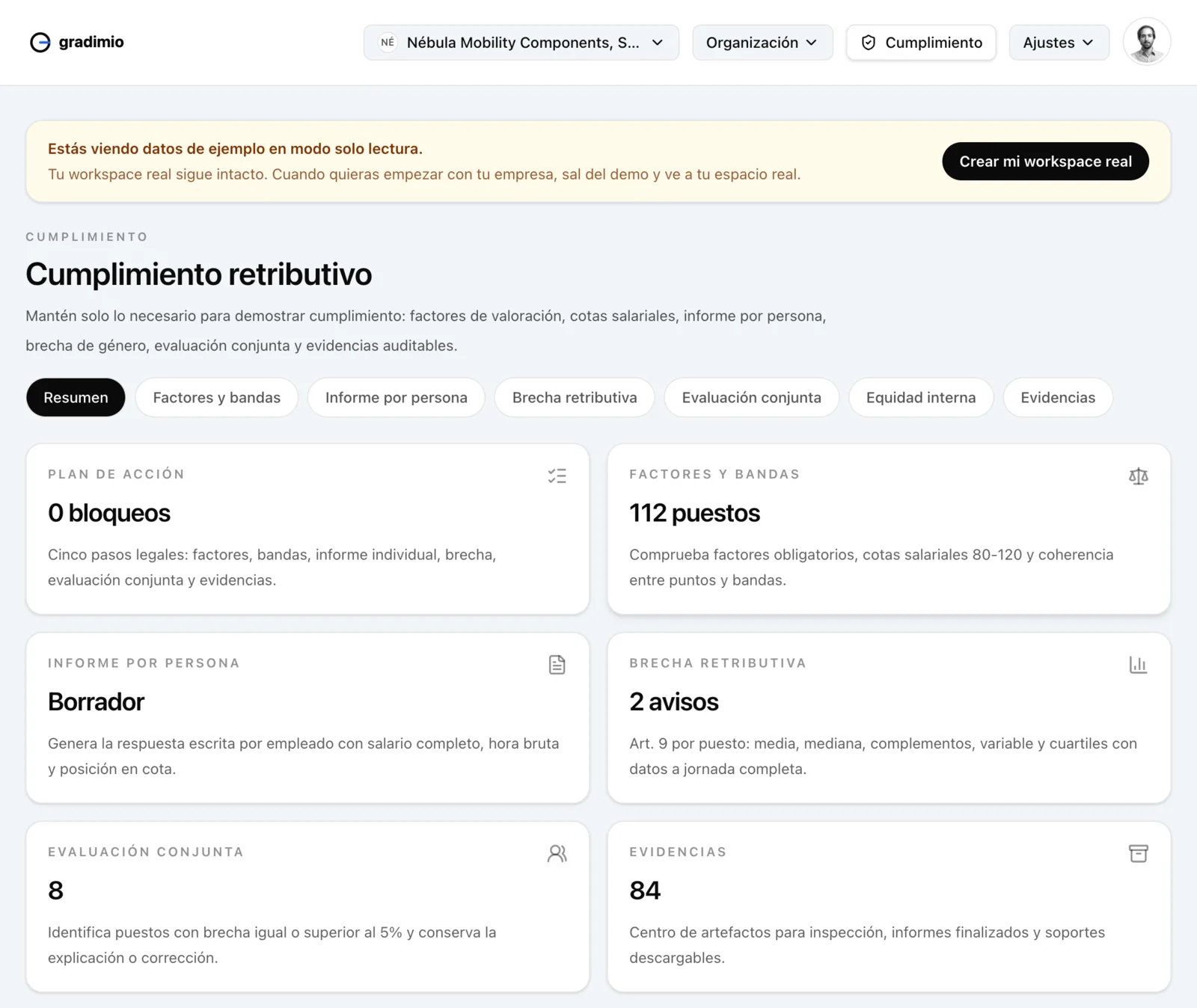
ComplianceExecutive checks are separated from detailed analysis.
Compliance status, blockers, warnings, and action areas are structured for review instead of buried in data tables.
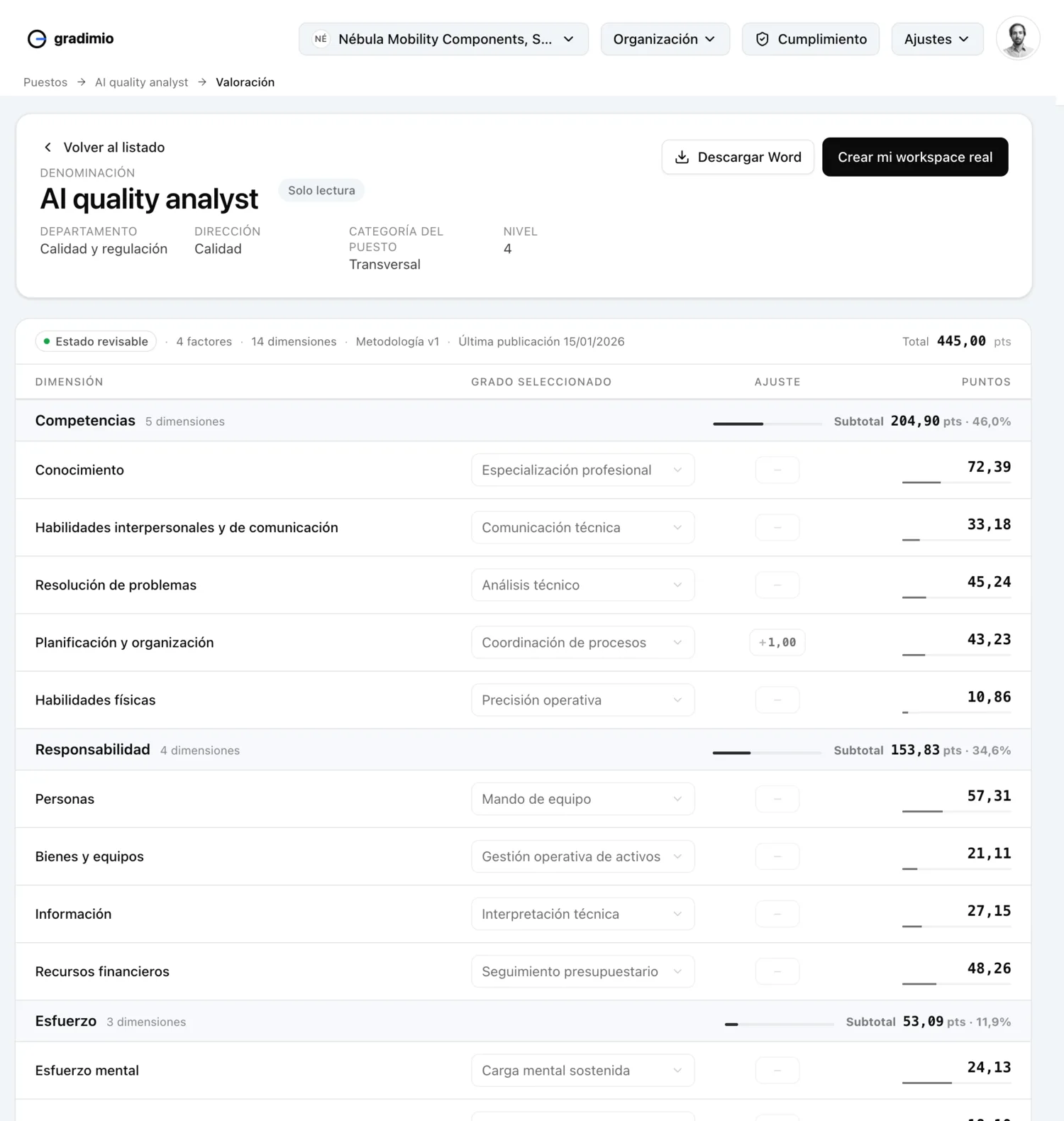
EvaluationJob valuation keeps scoring visible.
The detailed role screen exposes the valuation logic so sensitive compensation work stays explainable.
03 / Strategy choice cascade
The chain of choices behind the product direction.
This section is the product-management read: who the product is for, where it starts, how it can win, what capabilities matter, and how the work keeps learning.
Aspiration
Make job architecture and compensation decisions traceable, explainable, and compliance-ready.
Where to play
Spain-first HR, compensation, legal, leadership, and consultant workflows.
How to win
Turn expert-heavy compensation work into factor evaluation, role architecture, exports, evidence, and intelligence.
Sensitive products need traceable rules, not impressive automation.
The salary-intelligence work deliberately started with a small source-cited evidence pack rather than a broad automated benchmark promise. The point was to learn whether reviewer-facing evidence could be useful before making stronger claims.
That pattern repeats across the case: methodology versioning protects historical valuations, tenant-reference validation protects boundaries, and regulatory copy avoids collapsing distinct obligations into one vague compliance score.
06 / Product learning stories
Specific moments where judgment changed the work.
Interview-grade product stories: what was ambiguous, what I chose, and what the product learned from that decision.
Regulation to product
Legal obligations became auditable product behavior.
Constraint
EU and Spanish pay-transparency rules overlapped, and it would be easy to collapse legal thresholds, internal analytics, and reviewer evidence into one vague feature.
Decision
I separated obligations from internal-equity analysis and mapped the domain into data objects, workflows, evidence, permissions, and user actions.
Proof
The model covers equal-value groups, remuneration registers, worker requests, audits, corrective actions, and evidence without claiming legal conclusions.
AI validation
The first salary-intelligence product was an evidence pack.
Constraint
A broad AI benchmarking idea risked overbuilding automated salary answers before source quality, privacy boundaries, and reviewer trust were clear.
Decision
I tested the smallest valuable artifact: a reviewer-facing, source-cited evidence pack with provider scoring, privacy rules, and deterministic inclusion decisions.
Proof
The validation showed a useful review surface while making clear that automatic external-facing benchmarks were premature.
Methodology migration
A new scoring method could not break historical valuations.
Constraint
Changing the valuation method touched UI, APIs, imports, reports, and existing records.
Decision
I used a canonical scoring engine, methodology versioning, write-time calculation, staged migration, backfills, flags, canary gates, and rollback planning.
Proof
Historical valuations stay pinned to their method while future entry points calculate consistently.
Root cause
A vanished org chart was a data-invariant failure.
Constraint
An organization chart disappeared without a runtime error because circular, self-reporting, or rootless relationships broke the hierarchy.
Decision
I traced the issue to data invariants, repaired the records, added shared cycle detection, recoverable UI warnings, and API-boundary rejection for bad relationships.
Proof
The product now protects the hierarchy invariant instead of treating the issue as a rendering-only bug.
07 / Method bridge
How this case maps to the operating model.
Each flagship case shows the same pattern: use AI for leverage, keep judgment human, reduce product risk, and leave an operating loop behind the product.
AI-assisted build
Brief before build.
The work depends on product briefs, real-codebase context, implementation review, validation checks, and careful claims rather than one-off prompting.
Product judgment
Complex B2B product thinking for sensitive, evidence-heavy decisions.
The case reduces the major product risks while making the trust surface explicit: value, usability, feasibility, viability, and launch confidence.
Next learning loop
Pilot-stage product with deep product, compliance-readiness, security, and pricing systems.
The next step is better evidence: user behavior, pilot feedback, operational checks, security posture, and roadmap decisions.