Selected case study

Report 04 / Generative poster studio and export checkout

Live creative-commerce product with production security baseline.

04

Paliet

Generative poster studio and export checkout

A creative-commerce studio for personalized posters: live editing, generated maps and artwork, saved creations, high-resolution exports, checkout, and future physical-product experiments.

1

Hypothesis

Personalized art should feel intentional, not tool-heavy.

The product bet was that users want custom posters, maps, and generative compositions without learning a professional design tool or paying for bespoke design.

Creation path

The value is not AI novelty. It is output quality and control.

2

Coded prototype

The editor became a working creative-commerce system.

Paliet includes template rendering, map and star poster variants, saved libraries, export jobs, credits, checkout, account controls, and product-preview research.

Rendering stack

A product where design taste and technical rendering quality are inseparable.

3

Launch gate

Creative tools still need serious trust boundaries.

Security and privacy work covered origin checks, rate limits, export credits, webhook idempotency, Supabase RLS, data export, account deletion, provider boundaries, monitoring, rollback, and CI gates.

Trust checks

Even playful creative tools need launch-grade product operations.

4

Feedback loop

Product judgment includes knowing what not to ship.

The Dynamic Mockups spike proved technical viability, then paused the feature because render cost, watermarking, casual browsing, and purchase intent did not justify default runtime use.

Decision loop

Product judgment: viability and timing beat feature excitement.

Contents · 10
  1. 01 - Brief
  2. 02 - Claim
  3. 03 - Screens
  4. 04 - Strategy
  5. 05 - System
  6. 06 - Risks
  7. 07 - Stories
  8. 08 - Method
  9. 09 - Ops + trust
  10. 10 - Signal
The 90-second brief

The problem

Generative creative tools can produce attractive previews while still failing the product promise: the user needs control, saved work, checkout confidence, privacy rights, and high-resolution output that preserves the approved design.

What I designed and built

A creative-commerce studio with templates, live poster editing, city and star map modes, saved libraries, cart and checkout, export credits, account controls, privacy workflows, and security/rollback foundations.

What it proves

That I can combine visual taste, renderer discipline, commerce judgment, privacy, and go/no-go decisions in a product where the output itself is the trust surface.

Product owner-builderRole
Live creative-commerce productStatus
Preview/export fidelityTrust surface
Renderer and commerce gatesOperating model

01 / Builder signal

Creative quality, output fidelity, and business-model judgment.

Paliet shows the creative side of the same product-builder pattern: taste, editor UX, output fidelity, export quality, checkout, provider boundaries, data rights, and disciplined feature investment.

Product model
Creative studio plus export credits
Commerce model
Paid high-resolution export pack
Tradeoff
Dynamic mockups technically validated, commercially paused
The story

The hard part was preserving creative intent.

Paliet looks like the most playful case, but the product problem is serious: if a user approves a generated poster, the export has to preserve that decision. A beautiful editor is not enough if the downloaded result changes geometry, labels, framing, palette, mask, or resolution.

That made output fidelity a product invariant. The work had to connect visual taste, editor state, renderer behavior, checkout, account state, export credits, and privacy rights into one trustworthy loop.

The case also shows product restraint. Physical commerce and mockup providers were explored, but not shipped as default behavior when proof-order quality, provider geometry, licensing, cost, and purchase intent were not strong enough.
02 / Product evidence

Screenshots selected as product evidence, not decoration.

Selected screens from the actual product.

Curated live-product captures, cropped for readability so the product proof stays inspectable.

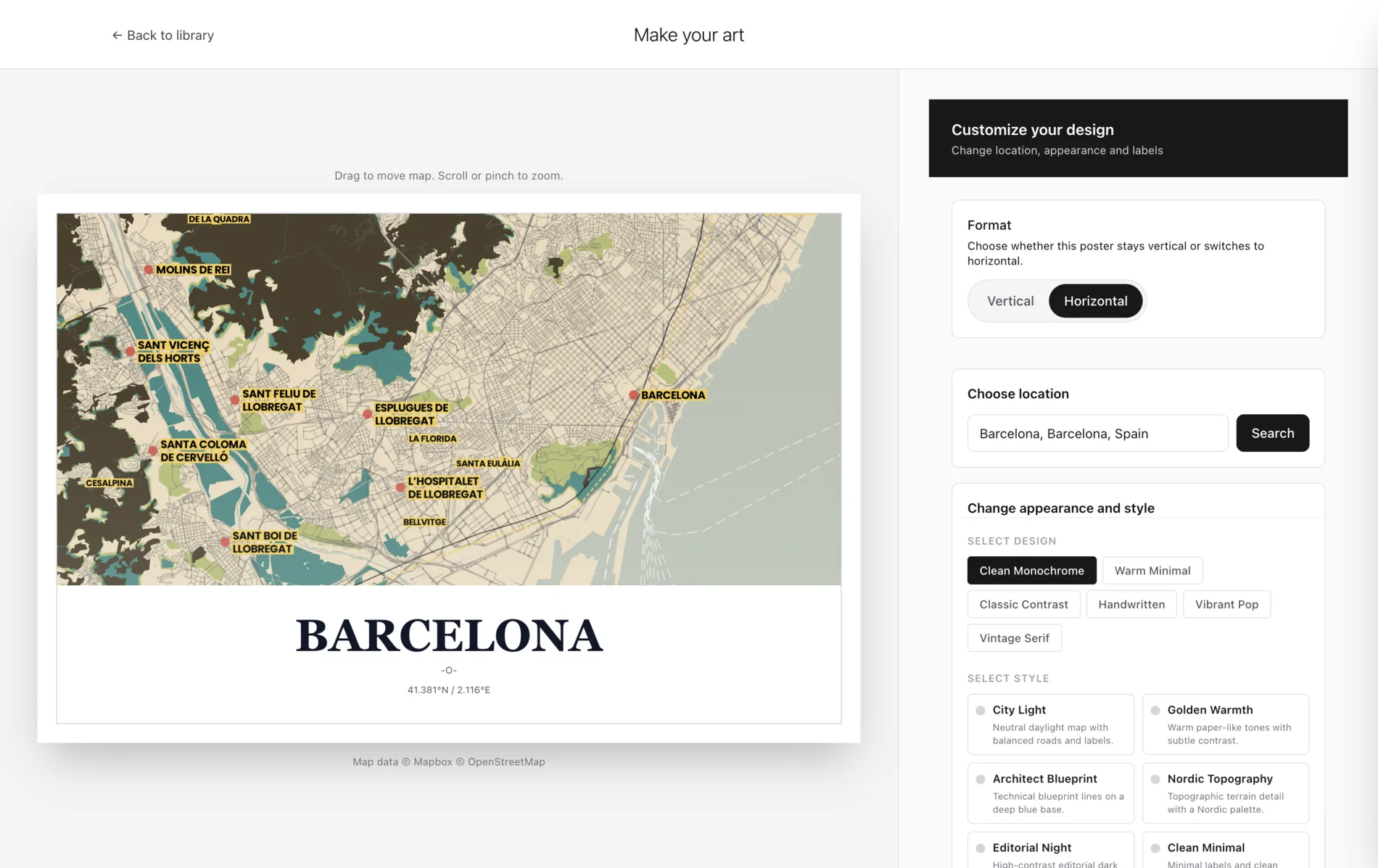
Paliet city map poster editor showing a Barcelona poster and customization controls.
Fig. 02 - Map poster customization with a live generated artwork.
  1. 1
    Live creative control

    The editor makes taste operational: format, palette, text, and map choices are exposed as product controls.

  2. 2
    Preview is the promise

    The generated poster is not decoration; it is the thing the user is deciding whether to save, export, or buy.

  3. 3
    Commerce depends on fidelity

    Checkout and exports only work as product experiences if the downloaded result preserves the approved preview.

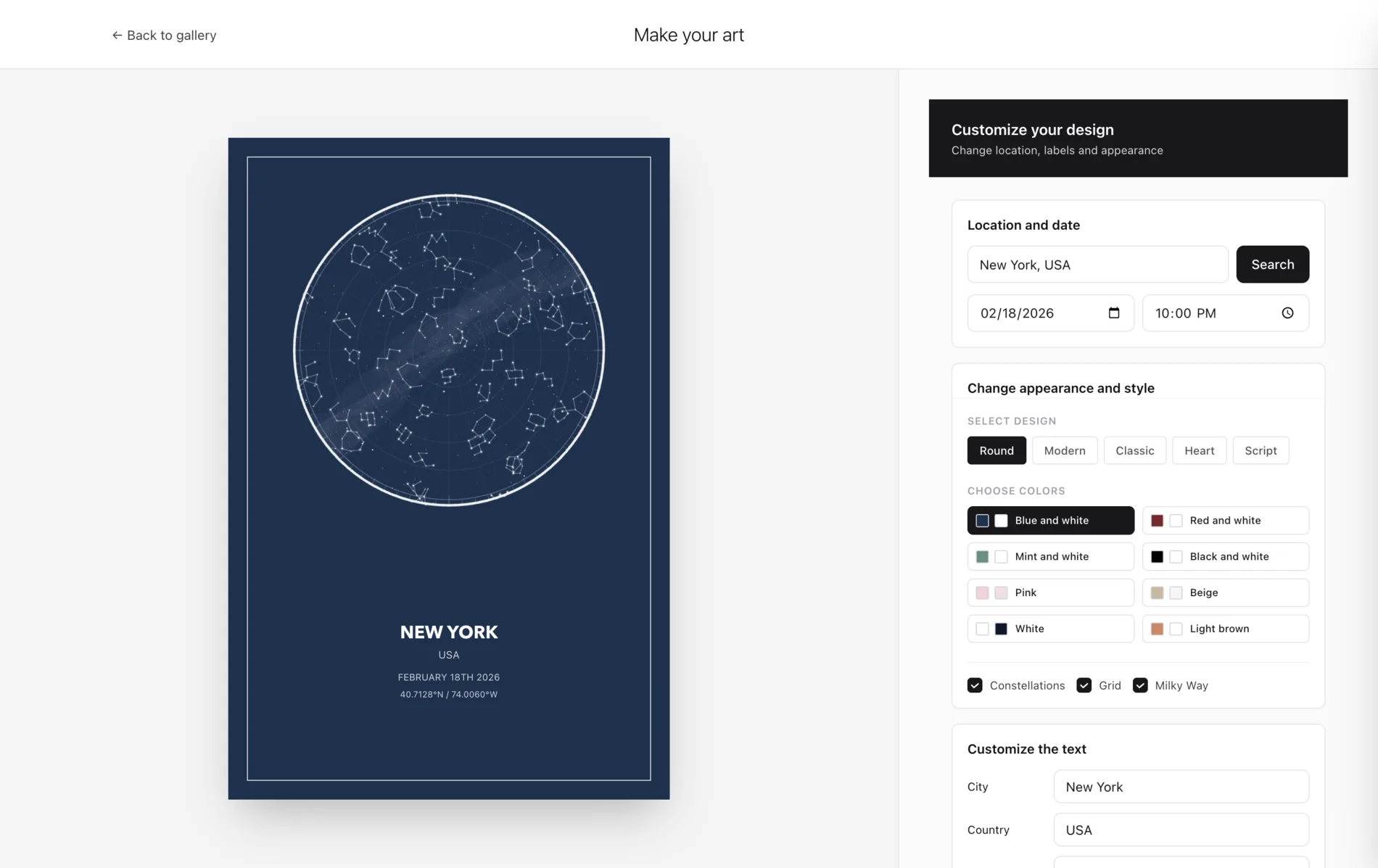
Paliet star map poster editor showing a New York night-sky poster and customization controls.
VariationA second poster mode without changing the product grammar.

Star maps reuse the same editor logic while giving the product a different emotional use case.

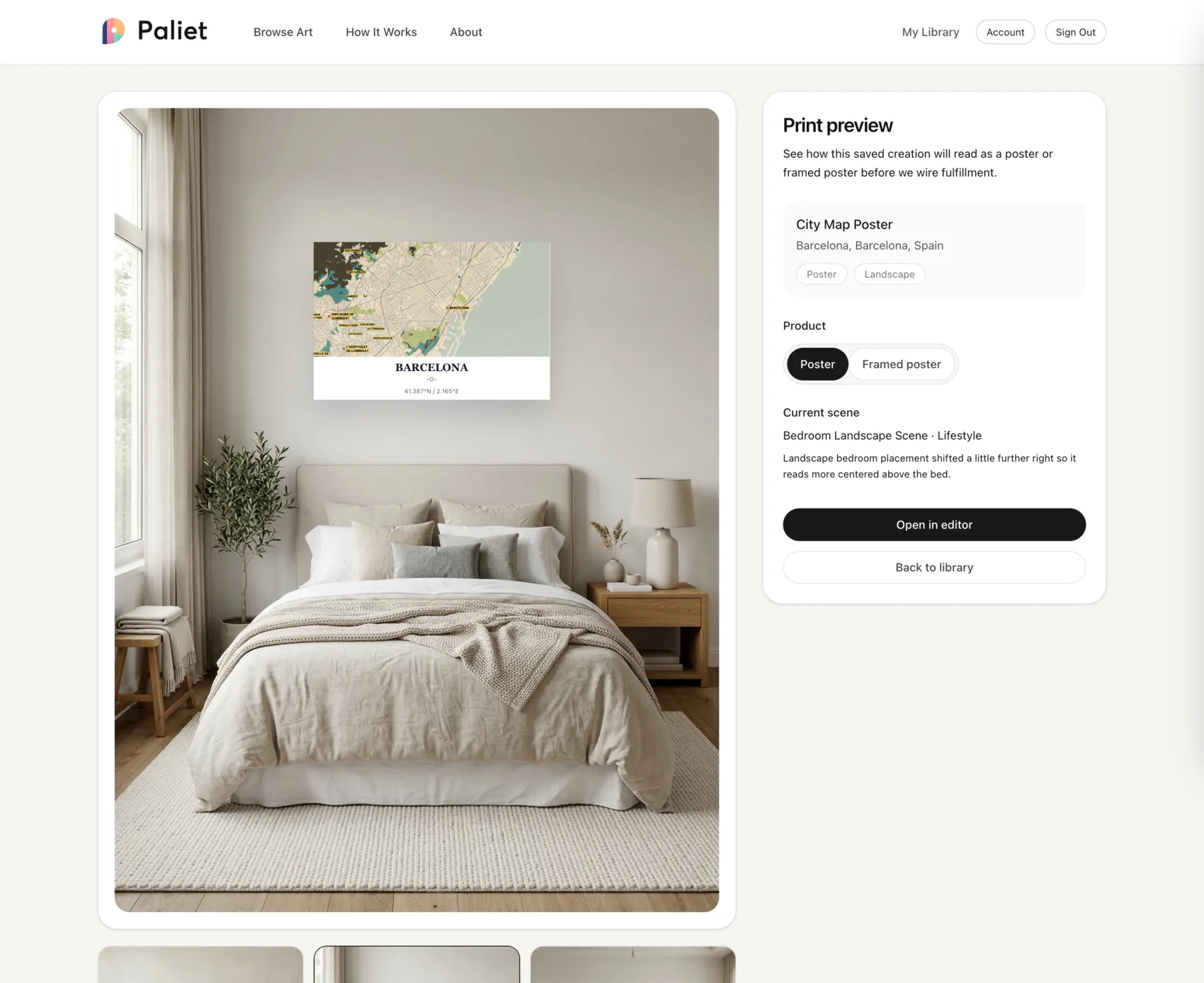
Paliet print preview showing a generated map poster in a bedroom scene with checkout controls.
CommercePrint preview turns generated output into a buying decision.

The bedroom mockup makes export and print intent tangible instead of abstract.

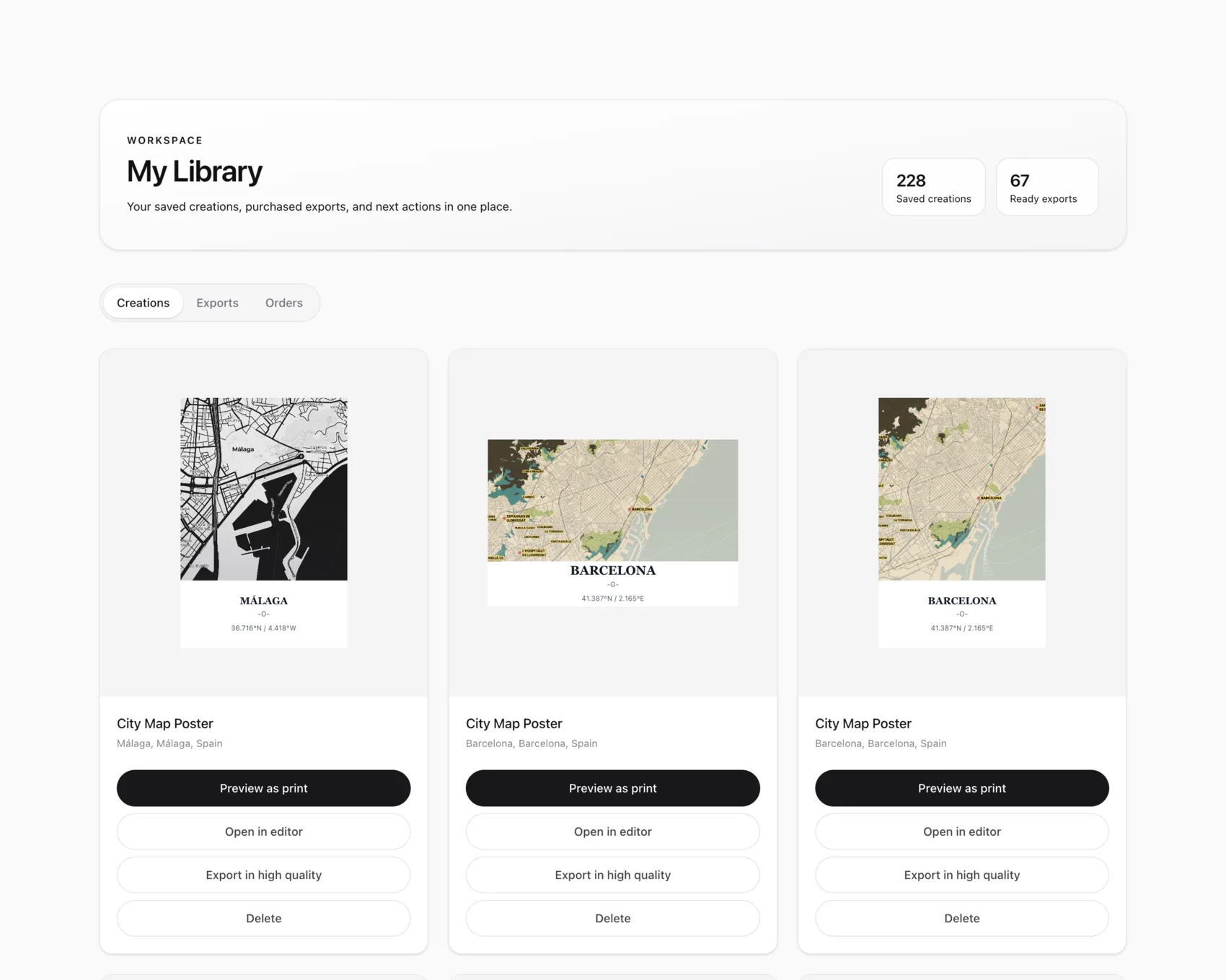
Paliet library page showing saved poster creations in a grid.
LibrarySaved creations create a durable studio surface.

The library shows that the product is more than a one-shot generator: users can manage outputs and return to them.

03 / Strategy choice cascade

The chain of choices behind the product direction.

This section is the product-management read: who the product is for, where it starts, how it can win, what capabilities matter, and how the work keeps learning.

Aspiration

Create a creative-commerce studio for personalized, print-ready generative artwork.

Where to play

People who want custom posters, maps, and star artwork without design-tool overhead.

How to win

Offer templates, editor customization, saved library, cart/checkout, high-resolution export, and careful feature investment.

Capabilities

Generative rendering, Mapbox, star maps, Supabase auth/storage, Stripe checkout, export pipeline.

Management system

Privacy model, account deletion/export, checkout/webhook checks, mockup economics, design quality gates.

04 / Product map

The users, surfaces, and capabilities behind the product.

Solo product builder across art direction, editor systems, rendering, commerce, privacy, security, and product economics.

Users

  • Creative buyers
  • Gift shoppers
  • People making maps and star posters

Product surfaces

  • Template gallery
  • Poster editor
  • Saved library
  • Export checkout
  • Account settings

Capabilities

  • Rendering
  • High-resolution exports
  • Credits
  • Provider boundaries
  • Privacy requests

05 / Product-risk model

Value, usability, feasibility, viability, and trust.

The risk map shows what had to be true before the product could be treated as more than a concept.

Value

Will users care about the output?

The product focuses on personalized artwork, map posters, star posters, and export quality rather than generic generation.

Usability

Can users get to a good result?

Templates, saved creations, previews, and export flows reduce design-tool overhead.

Feasibility

Can rendering and commerce work together?

The app connects editor state, export jobs, credits, Stripe checkout, webhooks, and account controls.

Viability

Should every technically viable feature ship?

Dynamic Mockups was validated, cost-modeled, and intentionally paused until demand justifies it.

Trust

Can user artwork and accounts be handled responsibly?

Privacy, retention, account export/deletion, RLS, origin checks, quotas, monitoring, and rollback are documented.

The lesson

Creative products still need operating discipline.

It is tempting to treat a creative tool as mostly visual craft. Paliet shows the opposite: user intent travels through renderer state, account state, checkout, webhooks, export jobs, privacy operations, and support decisions.

That is why the go/no-go moments matter. The product becomes more credible when it pauses a feature that is exciting but unproven, rather than expanding the surface faster than the trust model can support.

06 / Product learning stories

Specific moments where judgment changed the work.

Interview-grade product stories: what was ambiguous, what I chose, and what the product learned from that decision.

Platform expansion

Maps became a creation type, not a side feature.

Constraint
City maps and star maps could have fragmented the product into separate generators, libraries, checkout states, and export paths.
Decision
I made maps first-class creation kinds that share discovery, editor controls, saved library, cart, checkout, and export infrastructure.
Proof
Paliet supports artwork, city maps, and star maps through one account, library, checkout, and export model.
Export trust

The export had to preserve the approved preview.

Constraint
Some designs can look right in an editor but change at high resolution, especially when CSS, canvas, maps, masks, and print dimensions meet.
Decision
I treated preview/export parity as a trust invariant across rendering state, framing, seed, palette, camera, dimensions, and DPI metadata.
Proof
The export pipeline preserves the user-approved design instead of turning checkout into a surprise.
Go/no-go judgment

Physical commerce was paused after technical progress.

Constraint
Provider integrations and mockups could render promising previews, but fulfillment quality, mockup accuracy, and purchase intent were not proven enough.
Decision
I kept digital exports stable, archived the physical-product experiment, and defined a narrower restart around one verified SKU and proof order.
Proof
The work preserved provider mapping and mockup learning without shipping an experience that could misrepresent the delivered product.
Commerce integrity

Save, cart, payment, and export had to behave idempotently.

Constraint
Creative products create messy states: repeated saves, cart refreshes, checkout retries, webhook delays, and export-credit accounting.
Decision
I designed save/add-to-cart and payment flows around stable identifiers, webhook idempotency, and explicit export entitlement state.
Proof
The product can connect creation state to checkout and exports without making duplicate actions feel dangerous.

07 / Method bridge

How this case maps to the operating model.

Each flagship case shows the same pattern: use AI for leverage, keep judgment human, reduce product risk, and leave an operating loop behind the product.

AI-assisted build

Brief before build.

The work depends on product briefs, real-codebase context, implementation review, validation checks, and careful claims rather than one-off prompting.

Product judgment

Creative quality, output fidelity, and business-model judgment.

The case reduces the major product risks while making the trust surface explicit: value, usability, feasibility, viability, and launch confidence.

Next learning loop

Live creative-commerce product with production security baseline.

The next step is better evidence: user behavior, pilot feedback, operational checks, security posture, and roadmap decisions.

Read the playbook

08 / Operating loop

How the work moved from idea to launchable system.

  • Dynamic Mockups decision memo separates technical success from commercial readiness.
  • Privacy and retention spec defines export scope, deletion/anonymization, processor boundaries, and provider exceptions.
  • Security blueprint rollout records validation commands, production smoke, live headers, rollback tags, and follow-ups.
  • Export-credit model turns creative output quality into a simple, testable business loop.

09 / Trust layer

Trust as part of product management.

  • Origin checks, rate limits, response-safety validation, security headers, and CI security gates protect core flows.
  • Stripe webhook idempotency and export-credit accounting reduce payment and entitlement risk.
  • Account data export and deletion routes turn privacy rights into product surfaces, with provider exceptions documented.

10 / What this shows

The capability signal for product teams.