The opportunity was to combine public storytelling, campaigns, supporter data, certificates, and follow-up into one trusted operating surface.
Supporter journey
DiscoverDonateRecordCertifyFollow up
Move from a public donation moment to a durable supporter relationship.
2
Coded prototype
The prototype became a working operations product.
The product surface spans organization microsites, projects, products, recurring support, public checkout, certificates, admin review, email, content, and custom domains.
Real-codebase surface
public org pages
donations + products
Stripe + Resend
Supabase-backed state
Product leverage: coded workflows, not static mockups.
3
Launch gate
Trust became part of the product definition.
Launch readiness included payment integrity, tenant access, signed tokens, upload boundaries, privacy requests, admin evidence, localization, smoke tests, and production rollout checks.
Readiness checks
payment tampering fixed
private storage verified
webhooks signed
CSP and headers reviewed
production smoke gate
Trust/security was treated as a product requirement, not a cleanup phase.
4
Feedback loop
Pilot learning is more important than early public traffic.
Because Donaya is new, the signal is in pilot learning, product depth, launch discipline, content iteration, and the operating machinery around early users.
Learning loop
pilot orgs
admin review
pricing tests
content automation
Evidence-guided work: use traffic, security findings, and pilot conversations without overclaiming.
Small nonprofits run trust-heavy operations: donations, supporter records, certificates, events, and follow-up. When those jobs live across disconnected tools, the organization may be trustworthy while the workflow cannot show it.
What I designed and built
A fundraising operations platform with public campaigns, payments, supporter records, admin controls, certificates, events, follow-up loops, and launch gates, designed and implemented in a real codebase.
What it proves
That I can take an ambiguous, trust-critical domain from problem framing to an operating product: product judgment, UX, security posture, and post-launch learning loops in one system.
Product owner-builderRole
Live pilot-stage productStatus
Payments, PII, certificatesTrust surface
SHIP + OPERATE gatesOperating model
01 / Builder signal
Trust-heavy nonprofit operations with payments, admin controls, and follow-up loops.
Donaya shows how I turn a trust-heavy nonprofit workflow into a working product: public pages, organization controls, payments, certificates, admin review, launch gates, content operations, and security hardening.
Product model
Nonprofit fundraising operations
Business wedge
0% Donaya platform-fee positioning
Trust evidence
Security review, payment checks, and compliance docs
The story
A fundraiser's Saturday, before and after.
Before Donaya, launching a campaign could mean a payment link in one tool, supporter names in a spreadsheet, certificates assembled by hand, and follow-up that depended on someone remembering. The organization was trustworthy; the workflow had trouble making that trust visible.
The product collapses that into one path: publish a campaign, take the payment, record the supporter, issue the certificate, and create the follow-up. The design work was less about adding screens and more about deciding which actions require review, which records need stronger boundaries, and where the organization needs to see its operations at a glance.
That framing is what the rest of the case documents: the stage flow, the choice cascade, the risk work, and the moments where product judgment changed the build.
02 / Product evidence
Screenshots selected as product evidence, not decoration.
Selected screens from the actual product.
Curated live-product captures, cropped for readability so the product proof stays inspectable.
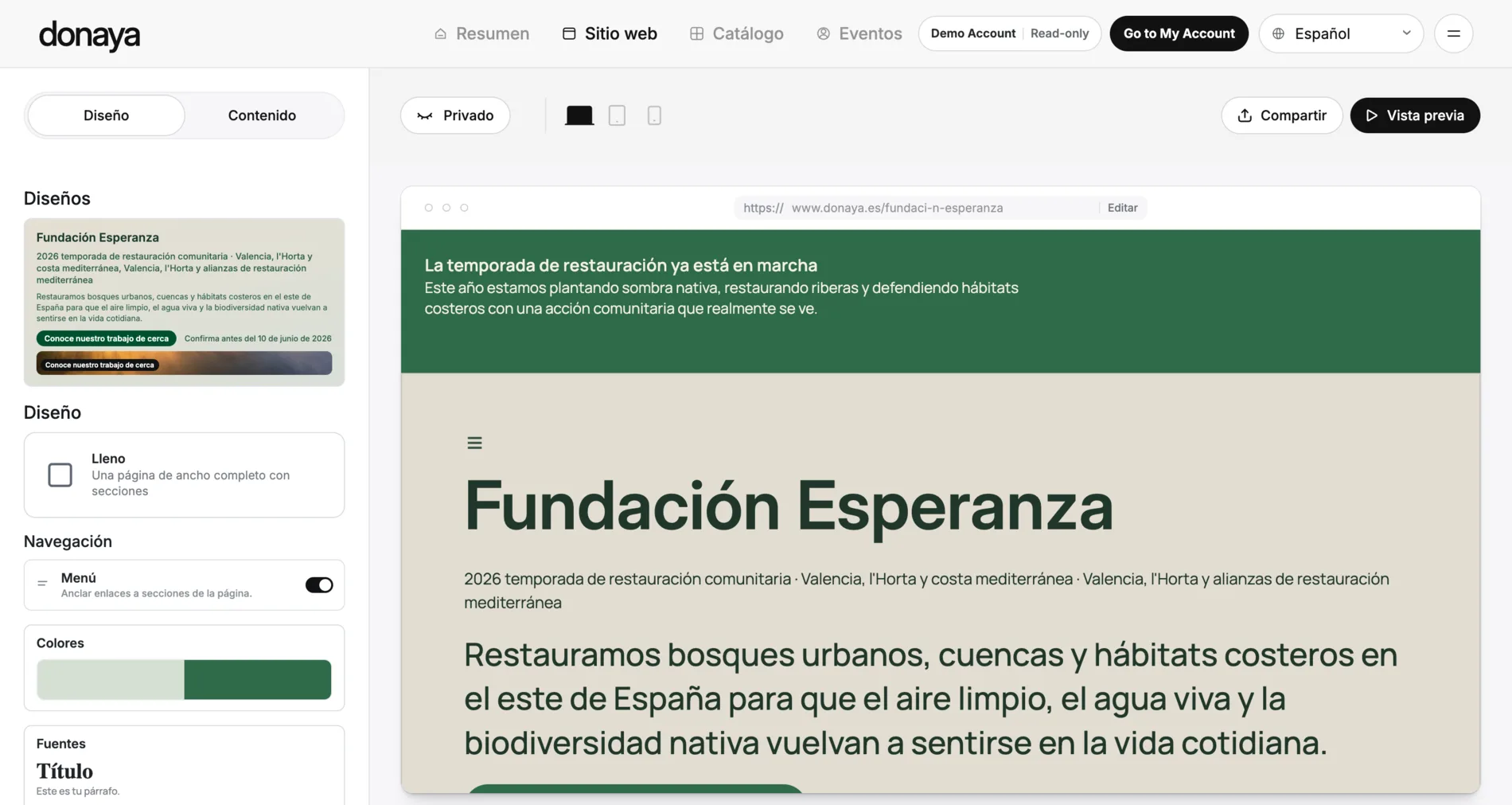
123Fig. 02 - Organization site editing with real campaign content.
1
Public promise beside operator control
The builder keeps the public campaign preview close to editing controls, so product copy, visual trust, and operational readiness stay connected.
2
Campaign story and contribution path
Fundraising is treated as a relationship surface: narrative, goal, donation mechanics, and follow-up start in the same product model.
3
Launch gate inside the workflow
The work is not just publishing a page. It requires review states, admin boundaries, and confidence that the public surface matches the organization intent.
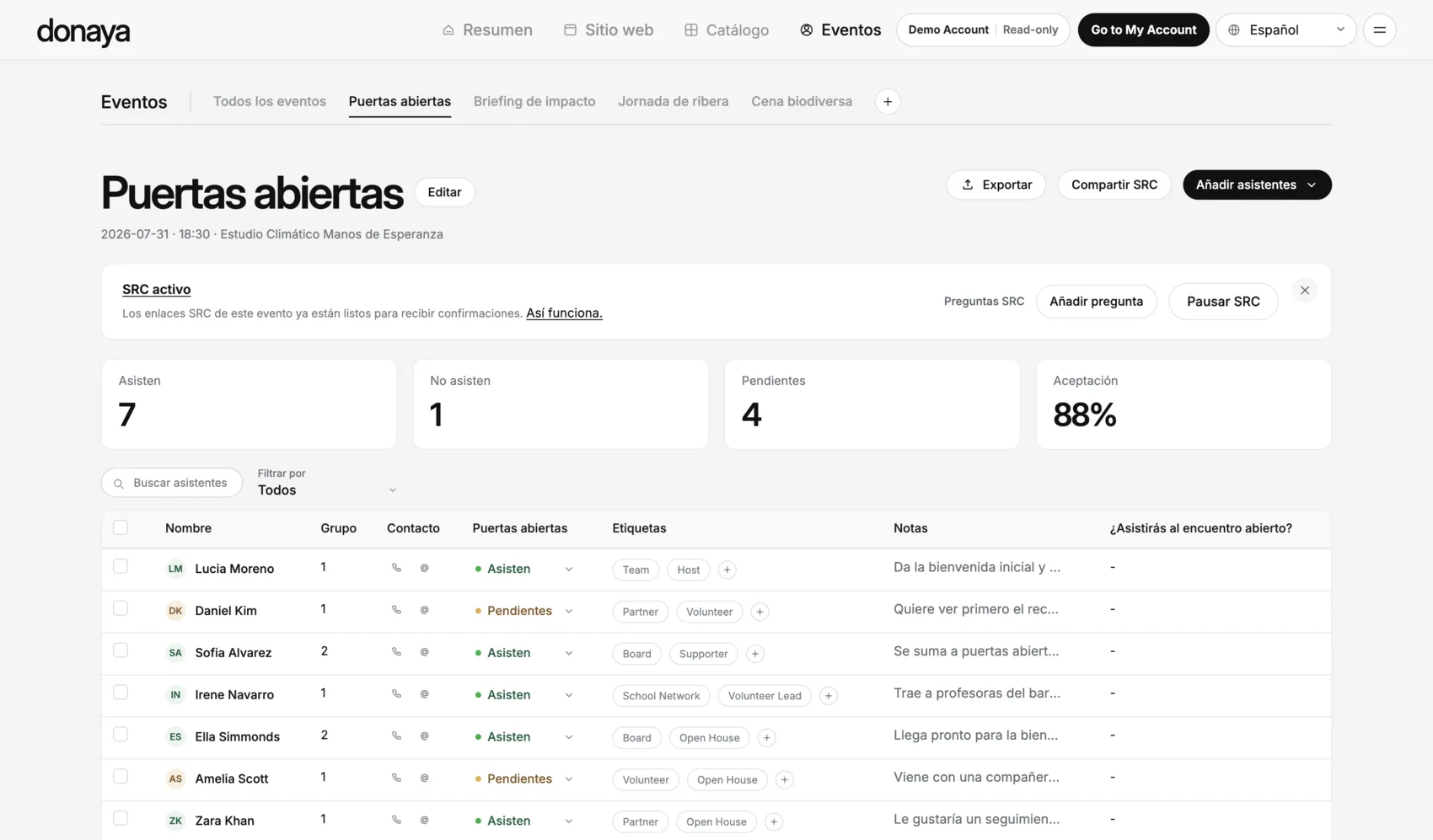
OperationsEvents and fundraising status in one workspace.
Tables, metrics, public status, and event management show the operational layer behind the public product.
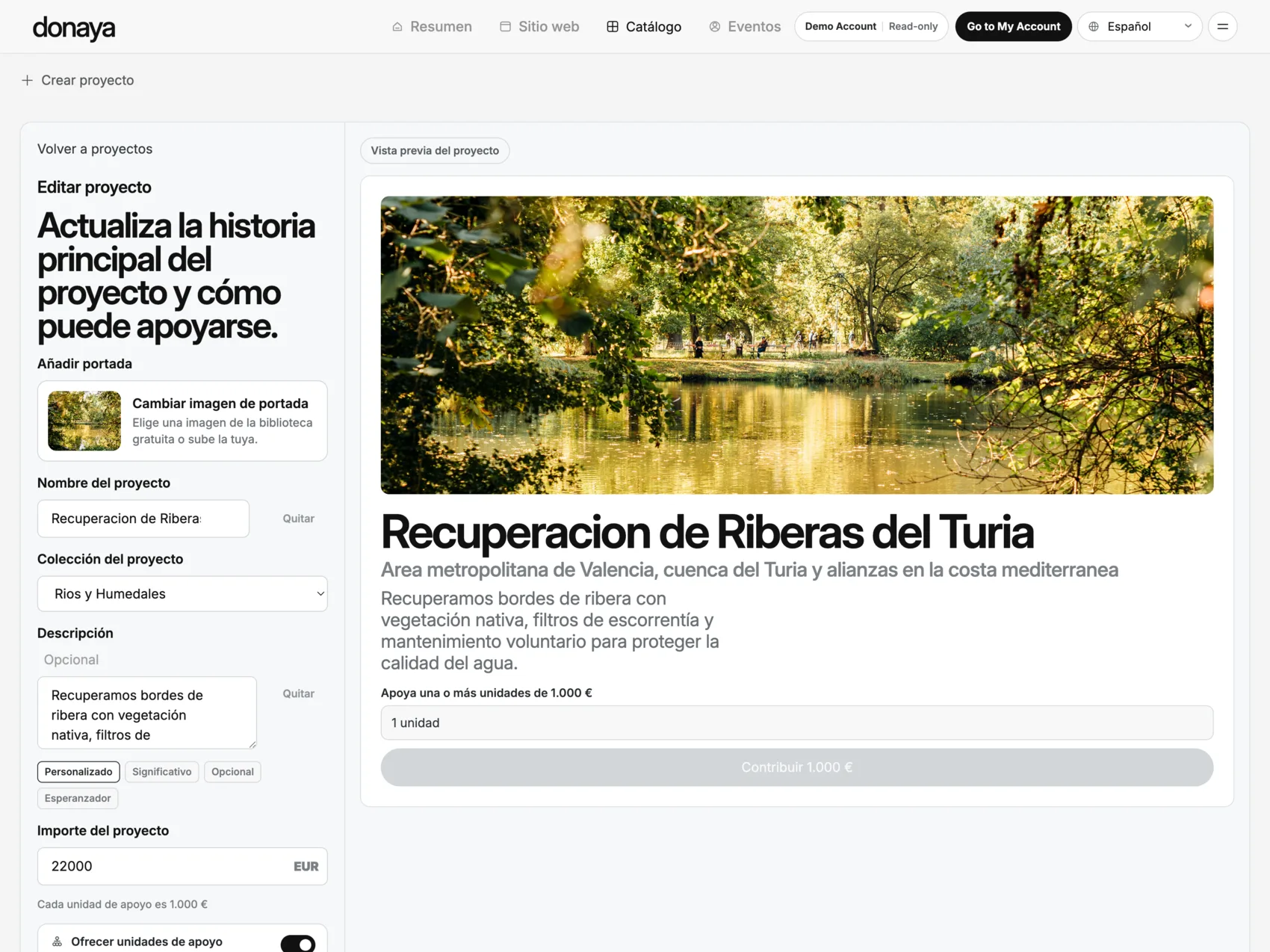
Campaign editorProject storytelling and donation mechanics together.
The editor combines narrative, media, goal setting, and checkout readiness instead of treating fundraising as a button.
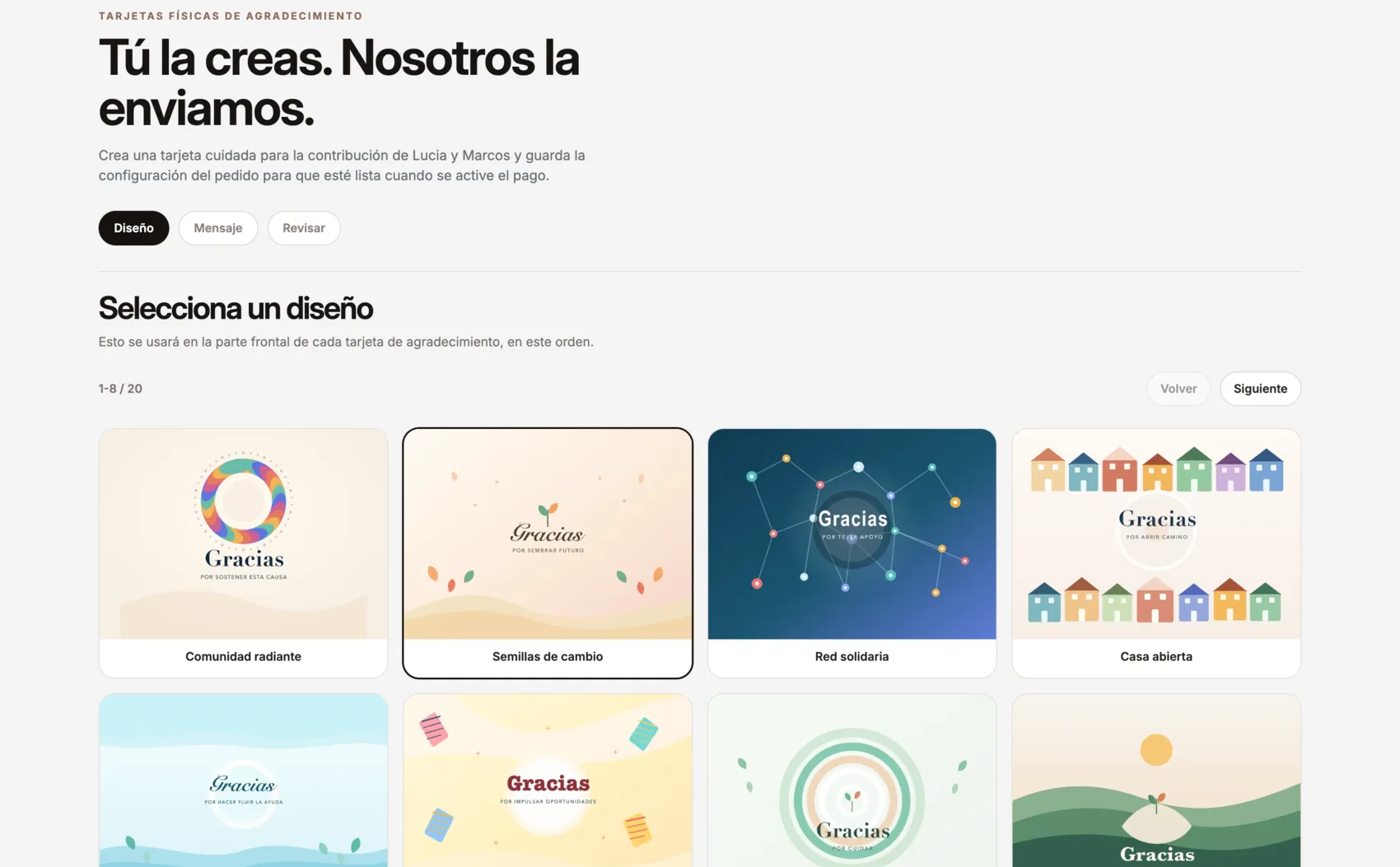
Follow-upA donor relationship continues after payment.
Thank-you card templates turn supporter follow-up into a designed product surface.
03 / Strategy choice cascade
The chain of choices behind the product direction.
This section is the product-management read: who the product is for, where it starts, how it can win, what capabilities matter, and how the work keeps learning.
Aspiration
Become an operational layer for mission-driven organizations.
Where to play
Spanish and European nonprofits that need fundraising plus supporter operations.
How to win
Combine public storytelling, payments, donor records, certificates, admin controls, and localization.
Pricing model, security reviews, blog automation, production smoke checks, pilot feedback.
04 / Product map
The users, surfaces, and capabilities behind the product.
Solo product builder across strategy, UX, architecture, implementation, launch, security, and operating model.
Users
Nonprofit operators
Supporters and donors
Admins and compliance reviewers
Product surfaces
Public organization pages
Donation and product checkout
Creator/admin workspace
Capabilities
Payments
Certificates
Email
Custom domains
Privacy workflows
05 / Product-risk model
Value, usability, feasibility, viability, and trust.
The risk map shows what had to be true before the product could be treated as more than a concept.
Value
Is this a meaningful user problem?
Nonprofits need public fundraising, records, follow-up, certificates, and admin visibility in one place.
Usability
Can operators and donors use it calmly?
Public flows and admin workflows are separated so donors see simplicity while operators keep control.
Feasibility
Can the system actually run?
Payments, storage, webhooks, email, custom domains, localization, and smoke tests exist in the app surface.
Viability
Can the model support the business?
The case explores pricing, platform-fee positioning, billing logic, and pilot rollout rather than only UI.
Trust
Can sensitive flows be launched responsibly?
Security launch work covered route inventory, signed cookies, upload boundaries, webhooks, CSP, and privacy tooling.
The lesson
Fast only works when feedback becomes structured.
The report identifies Donaya as the clearest rapid formation case, but the important point is not raw speed. The product moved quickly because domain objects, user responsibilities, trust boundaries, and operational risks were made explicit before complexity hid inside the implementation.
Pilot feedback then became part of the product-development system. Each point could be treated as a defect, expectation gap, permission decision, or new feature, with reproduction evidence, preview checks, and a factual response record. That made early user signal useful without pretending it proved more than it did.
06 / Product learning stories
Specific moments where judgment changed the work.
Interview-grade product stories: what was ambiguous, what I chose, and what the product learned from that decision.
Workflow model
Fundraising had to become an operating system, not a donation page.
Constraint
A donation moment is only one part of nonprofit work. Teams also need campaign content, supporter records, certificates, product sales, events, follow-up, and admin visibility to stay connected.
Decision
I modeled Donaya around the full supporter loop: public storytelling, contribution flows, donor records, certificate generation, thank-you actions, organization controls, and launch/admin review gates.
Proof
The pilot surface lets a nonprofit review the path from public campaign page to payment, operational records, certificates, and follow-up without splitting the work across unrelated tools.
Pilot feedback
Ambiguous operator feedback became a product system.
Constraint
Early feedback mixed defects, UX gaps, permission questions, and new feature requests, sometimes without enough evidence to reproduce the issue.
Decision
I classified each point, created QA data, used preview deployments, requested exact evidence, and kept a factual release record.
Proof
The loop turned support noise into fixes, clearer preview fidelity, and a stronger feedback contract for future pilot work.
Access model
Multi-user access shipped without unsafe shared accounts.
Constraint
Real organizations needed collaborators, but donor data, payments, certificates, and compliance actions made shared credentials unsafe.
Decision
I designed owner and manager roles, expiring email-bound invitations, server-side RBAC, revocation, last-owner protection, audit records, and sensitive-operation limits.
Proof
Organizations can invite collaborators while billing, payouts, exports, and compliance-sensitive actions remain protected.
07 / Method bridge
How this case maps to the operating model.
Each flagship case shows the same pattern: use AI for leverage, keep judgment human, reduce product risk, and leave an operating loop behind the product.
AI-assisted build
Brief before build.
The work depends on product briefs, real-codebase context, implementation review, validation checks, and careful claims rather than one-off prompting.
Product judgment
Trust-heavy nonprofit operations with payments, admin controls, and follow-up loops.
The case reduces the major product risks while making the trust surface explicit: value, usability, feasibility, viability, and launch confidence.
Next learning loop
Newly launched pilot-stage product.
The next step is better evidence: user behavior, pilot feedback, operational checks, security posture, and roadmap decisions.