Featured case file

keymodels.co / Business-model knowledge library

Live knowledge product · Decision library and templates

Key Models

Business-model knowledge library

A decision library for business models and strategy frameworks, with search, model pages, semantic diagrams, templates, packs, and editorial QA workflows.

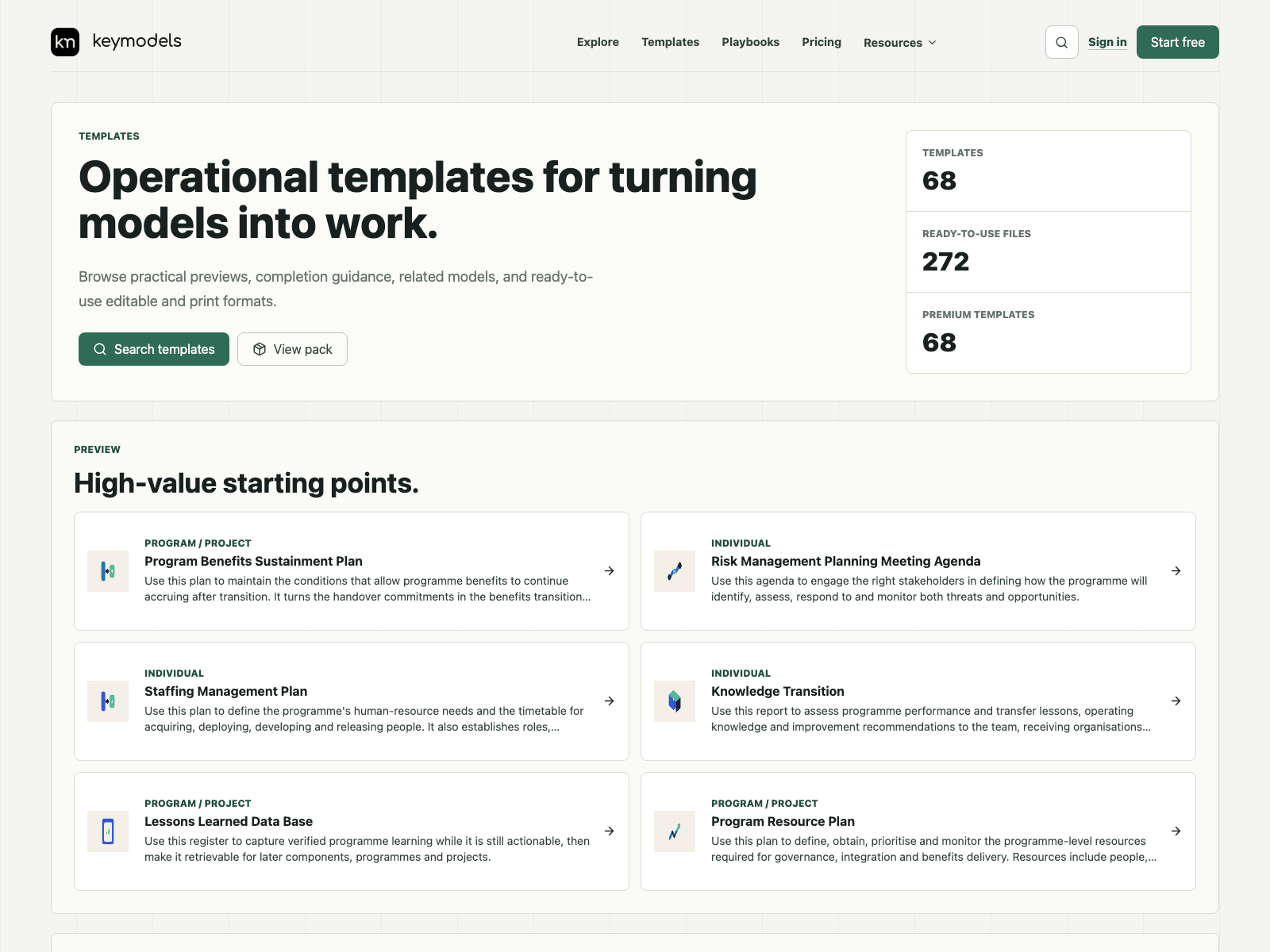
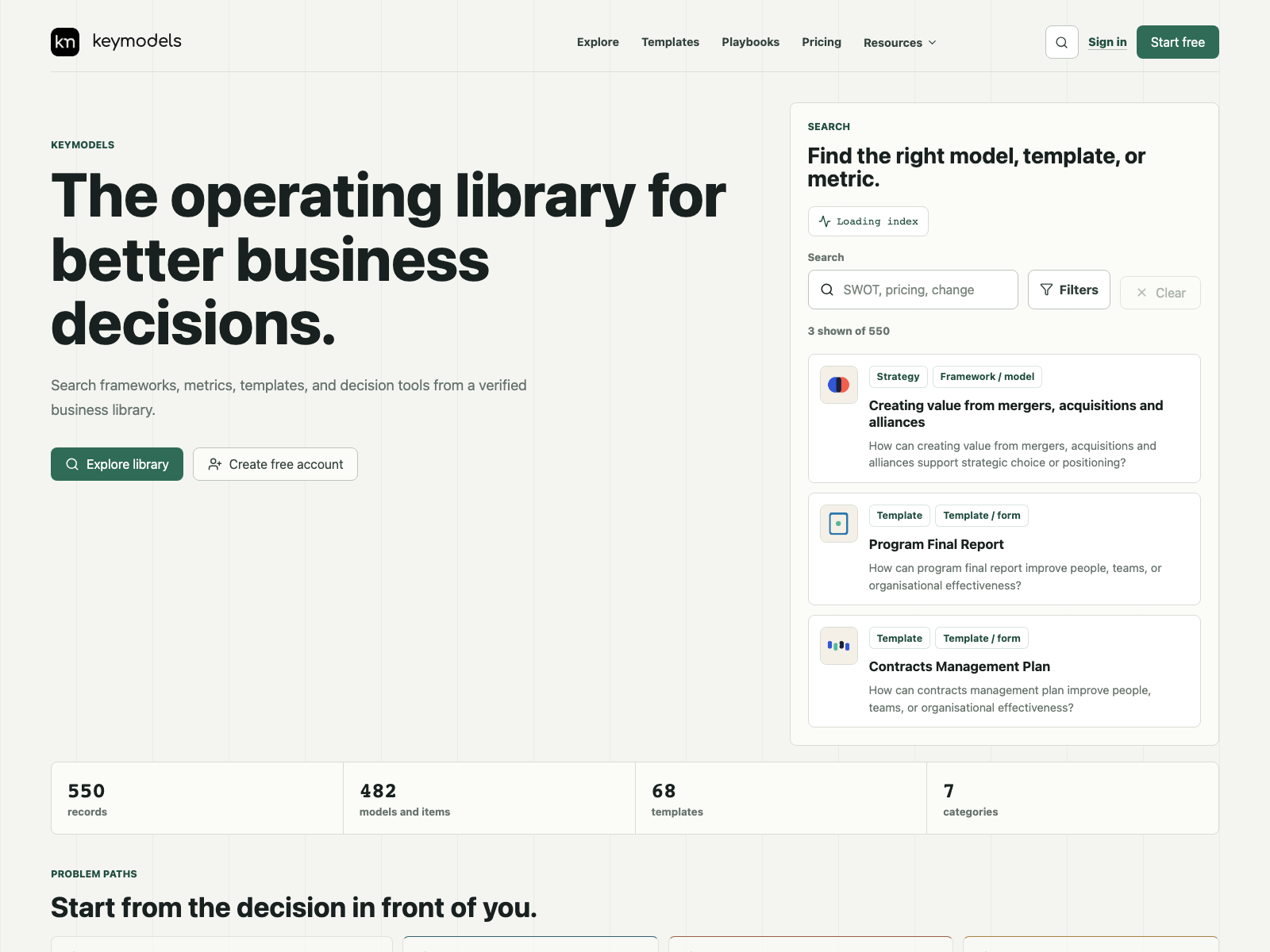
Key Models homepage with search, model results, templates, and category counts.
Library home

Why it belongs

What this project shows.

A knowledge product that turns a large corpus into a navigable product surface with source-faithful visuals, practical templates, and reviewable quality systems.

Product strategy, information architecture, corpus migration, semantic visual system, article UX, template productization, QA workflows, and full-stack implementation.

Capability signals

Product learning stories

Specific decisions behind the product surface.

A project can look like an archive entry from the outside. These stories show the product judgment, quality bar, and operating system behind it.

Decision architecture

The library had to answer a user question before showing a model.

Constraint
A large corpus of frameworks can become a beautiful archive that still leaves the reader asking which model applies, when to use it, and what to do next.
Decision
I organized the product around decision context: search, categories, model metadata, related frameworks, templates, packs, and saved-library paths that connect reading to action.
Proof
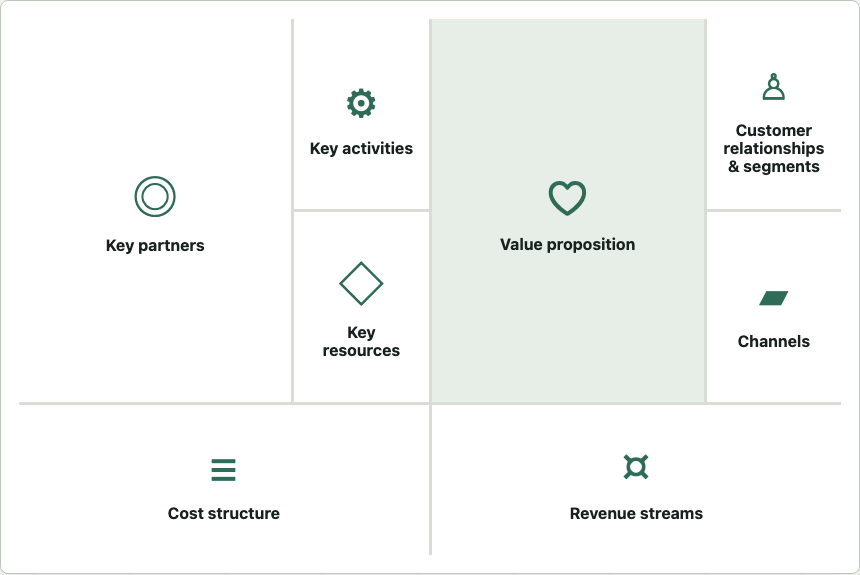
Key Models now presents models, templates, metrics, and categories as one navigation system, so a reader can move from question to framework to reusable artifact without treating every article as an isolated page.
Review workflow

Manual review became a product workflow.

Constraint
Chat-based review could not keep approvals, notes, corrections, figures, and resources synchronized across a large knowledge corpus.
Decision
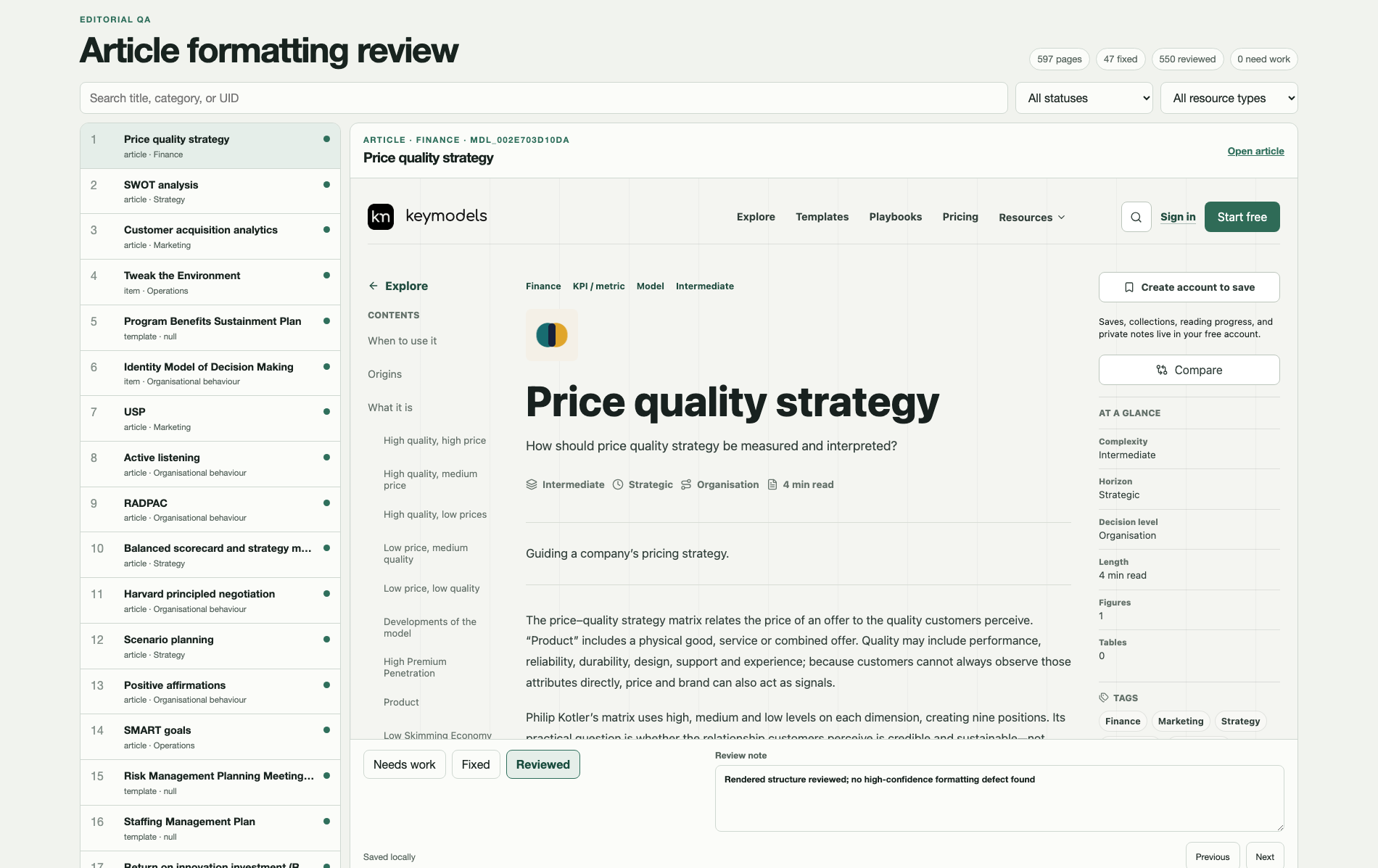
I turned the process into a two-pane real-page review dashboard with a JSON ledger, Excel snapshot, queues, notes, and approve/save-and-next actions.
Proof
The work created a repository-backed review system where page decisions, figure decisions, and remaining tasks stayed inspectable.
Template productization

Developer-facing assets became reader-ready resources.

Constraint
Template pages exposed fields, schemas, protected-resource metadata, and internal implementation concepts that would not help a real reader.
Decision
I reframed the output around what a serious reader or buyer should receive: editable docs, spreadsheets, PDFs, Markdown, completion guidance, and stable responsive layouts.
Proof
The template work became a product-design exercise, not just a file conversion exercise.
Knowledge graph

One internal-link insight became corpus-wide navigation.

Constraint
Hundreds of related frameworks behaved like isolated documents, which made the library harder to browse and learn from.
Decision
I built an idempotent relationship audit that added contextual internal links while avoiding self-links, broken destinations, bibliography pollution, and ambiguous matches.
Proof
The product gained a stronger knowledge graph and a cleaner path between related models.